


Posted by taxguru on April 6, 2006
Posted in Uncategorized | Comments Off on Adding more stress to Tax Season:
Posted by taxguru on April 6, 2006
From Mallard Fillmore:
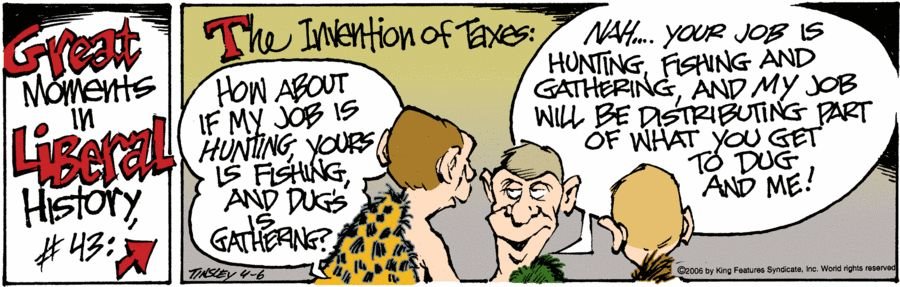
(Click on image for full size)

Posted in Uncategorized | Comments Off on Invention of Taxes
Posted by taxguru on April 6, 2006
Q:
Subject: tax guru questionGreetings Kerry,I just have one question. First of all, I really enjoyed your site. Very informative. My questions is what is the penalty for filing your taxes as a single when in reality you are married. Even though I am married, I recently got seperated from my wife. I was planning to file as a single and so was she. Thanks for your help.
A:
You both are treading into dangerous territory if you are serious about filing as Single when you were legally married as of 12/31/05.
If there are kids involved and you meet several qualifying tests, you and/or she may possibly qualify to use the generous Head of Household status. Your professional tax advisor can help you determine if you qualify.
If you don’t qualify for HoH status, you need to either file a joint return or as Married Filing Separate, which does have several penalties built into it. To file as Single is technically filing a fraudulent tax return, which then gives IRS a lot of power over you, including the assessment of penalties and the removal of the statute of limitations. With a normal honest tax return, IRS has three years to come after you. With a fraudulent tax return, they have forever to come after you.
Give those points some deep consideration before sending in a 1040 claiming a bogus filing status.
Kerry Kerstetter
Follow-Up:
Thank you very much for your help.

Posted in Uncategorized | Comments Off on Use Correct Filing Status
Posted by taxguru on April 6, 2006
Q:
Subject: Property Mgmnt /QB’sKerry after reading through your website I have come to the conclusion that you may be the only “QBGURU” that could efficiently help if you will?
I am very familiar with QB’s but am finding it difficult to set up rental property in QB’s so that I may track income and expenses as well as the security deposits. Without going into too much detail and wasting your valuable time maybe you are willing to help me with this?
Much thanks,
A:
It’s very easy to do with the Class feature. Set up a class for each property and when entering each income & expense item, assign the appropriate class. You can also use sub-classes to group properties, such as by address or by owner if you are doing property management for other people. When setting up your P&L, just specify that the columns should be arranged by Class and then you will get a separate side by P&L for each property. I use this every day when working with clients’ books to prepare their tax returns and it works beautifully. I explained Classes on my website.
Security deposits need to be treated a little differently because QB doesn’t allow you to set up a Balance Sheet with columns by Class.There are two main ways I have seen for keeping tabs on security deposits. One way is to have a sub-account for each tenant. The problem with this approach is that it makes the Chart of Accounts grow rather large and unwieldy. Accounts for tenants who have left can be tagged as Inactive after being zeroed out; but there could still be a lot of accounts to wade through.
The other approach is the one I use for keeping tabs on the trust funds Sherry’s exchange company is holding for client reinvestment. There is just one current liability account called Client Trust Funds. Each entry in and out is tagged with the customer name. We run transaction history reports with totals by Customer in order to see a detail of each client’s account. This could just as easily be done for tenants. In order to print out a detail for just one client (tenant), we check the box called “Page break after each major grouping” and it puts each client on a separate page. We page though to find the client we want to print out and just print that page.
I hope this helps. It’s really pretty easy; but you can probably get some personal assistance from a QB ProAdvisor in your area.
Good luck.
Kerry Kerstetter

Posted in Uncategorized | Comments Off on QB For Rental Properties
Posted by taxguru on April 6, 2006
Q:
Subject: Seminar
I’d like to echo the sentiments of one of the recent emailers who said they would come to a seminar of yours. I live in Washington DC but would travelanywhere to hear you speak and share your knowledge.Please consider it. Thanks.
A:
I appreciate that feedback. I am not a big fan of long distance travel, so the chances of my doing any live seminars outside of our local area are very slim.
However, I am looking into the logistics of doing some online seminars and will probably be doing a few live mini-seminars in the local area that we will tape and make available via CD and MP3 download.
I will definitely announce anything in that regard on my blog.
Thanks for writing.
Kerry Kerstetter

Posted in Uncategorized | Comments Off on Seminars
Posted by taxguru on April 6, 2006
Q:
Subject: Questionable taxes due for 2006?
My partner an I are co owners / co borrowers of a residence we have resided in since 2000. We are in the process of disolving this partnership and she will be buying out my share of the property and assuming all loans and debits. My question is, on the money I receive, will I need to pay taxes on it for the year of 2006? The residence was not sold nor refinanced but her att. said we needed to have the residence appraised and that the monies given to me have to be filed as income? Can you Help???
It sounds like you are selling your half of the home to your co-owner; so this will need to be reported on Schedule D of your 1040.
You didn’t give any figures, but if your profit on this sale is under $250,000, it should be tax free.
You should have been keeping tabs of your cost basis in your half of the home, starting from the original purchase and including any capital improvements you’ve made up until the time of your sale. Subtract that from the value you assign for the buy-out and you will have your profit.
If the profit on your half of the home is over $250,000, you will have a taxable long term capital gain. What you do with the money will make no difference whatsoever on the taxation of the home.
This isn’t very complicated, so any tax pro should be able to help you report it properly on your 1040. I have all of the rules on home sales on my website.
Good luck. I hope this helps.
Kerry Kerstetter

Posted in Uncategorized | Comments Off on Selling Out To Co-Owner
Posted by taxguru on April 6, 2006
Q:
Subject: Sub S Corp QuestionMr. Kerstetter,
First, I would like to thank you for your informative web site. You have effectively detailed many of the pros and cons of incorporating.
My question is, do expenses such as buying a company car offset any income acquired by the corporation? I was reading about the man who earned 300k but only took out 30k for himself on your website. Didn’t the corporation make the 300k profit? If so, and it was retained within the corporation for operating capitol, why did he have to show it as income?
A friend and I are considering forming a Sub S Corp and I am trying to learn as much as I can prior to beginning the process. As things are, I will own 49% of the stock and Eric will own 51%. We have the potential to generate well over 500k within the first year and a half to two years. After that, there is the potential to make literally millions. For this to work, we will need to keep a majority of the profits within the company for the second and third phase of our business plan. We will only be taking out 30k to 35k apiece. Is there any way to keep the income within the company without having to pay through the nose for income that we are not seeing the benefit of?
Eric is strongly in favor of the Sub S because he says that the dividends that we are paid are not subject to social security tax. I am concerned that he is being a little short sighted.
Thank you so much for your time.
A:
While I do appreciate the fact that you are doing research on the issues surrounding working with corporations, there is no book or online reference (including any of mine) that can substitute for the real world services of a qualified tax professional who can thoroughly analyze your particular circumstances.
You do seem to be very confused about the workings of pass-through entities, such as S corps, partnerships, and LLCs that elect to be taxes as partnerships or S corp. For Federal income tax purposes, these entities do not pay any income taxes. Their net income or loss is passed through to the income tax returns of the shareholders, who are required to include it on their 1040s regardless of how much actual cash (if any) the shareholders received. The example to which you referred is a very common situation, where the S corp has a very large net taxable profit, but doesn’t distribute any actual cash to the shareholders because of investment or operating requirements. The shareholders are still required to pay income taxes on that income and come up with the cash to pay them from whatever sources they can utilize.
Depreciation and Section 179 expensing of business equipment, including some kinds of vehicles, can reduce the corp’s taxable income.
A C corp pays income tax on its net taxable income, which could be high if excess cash revenues aren’t spent on deductible things.
There is no easy one size fits all answer to your needs. You should also be open to the fact that you may not want one entity to cover every aspect of your business. Multiple C and S corps may very well work out best for you and your business partner.
Again, it can get very complicated and is something that you definitely need to work on with a competent tax pro.
Good luck.
Kerry Kerstetter

Posted in 179 | Comments Off on S Corp Confusion
Posted by taxguru on April 6, 2006
Q:
Subject: C vs SHi Kerry,Very informative site. Which entity is better when a Company is sold? Assuming a typical transaction would be an asset sale.Thanks
A:
There are too many possible variables for there to be a universal answer to that. It all depends on the facts and circumstances.
Kerry Kerstetter

Posted in Uncategorized | Comments Off on C vs S Dilemma
Posted by taxguru on April 6, 2006
Q:
Subject: Sale of Personal Residence
Hi Kerry,
I have received conflicting advise and found you during my research on the internet.I own a condo in which I have considerable equity and lived in for 17 years. Nearly 3 years ago I bought a townhome and borrowed against the condo equity for my down payment. For a variety of reasons, I didn’t decide to sell the condo until this past month. Here is my dilemma:At the end of May I will have been living outside of the condo for three years and will lose my exemption benefit. The condo needs some work to get full value and I fear that by the time I get the work done and can find a buyer that I will not be able to close in time to preserve my exemption. Since the condo needs work, I thought that perhaps I could sell the condo to an LLC or S or C Corporation which I control and then fix it up and sell it, essentially flipping the property. Or selling it to a relative to accomplish the same thing.I’ve been told by one CPA that neither sale would be respected by the IRS and another says there are no rules about sales to relatives or to entities that are controlled by the seller – except for the remainder interest discussed on your site. I haven’t been able to find any discussion of similar circumstances by searching the web. I’m simply looking for a way to preserve my exemption as my gain will be considerable.Thanks for any insight or direction you can provide.
A:
I’m not aware of any new restrictions on sales to related parties since my earlier posting about selling a home to a controlled LLC.
One of the nice benefits of producing this blog is the volume of feedback it receives, especially if another tax pro thinks I missed something or misstated any facts. So far, nobody has piped up with any arguments over that issue; so it seems that it should work for your particular situation.
Good luck.
Kerry Kerstetter

Posted in Uncategorized | Comments Off on Selling Residence To Related Parties


 Tax Guru - Ker$tetter Letter