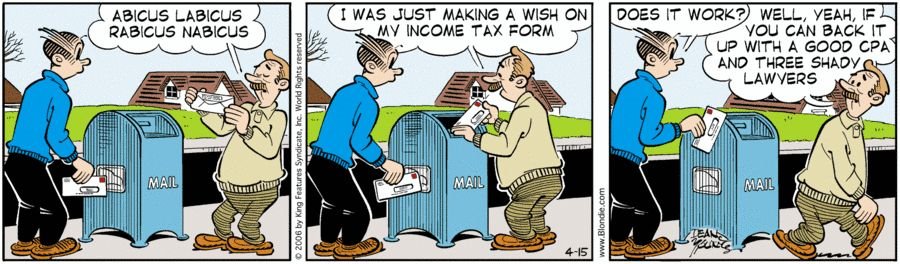
(Click on image for full size)


Posted by taxguru on April 15, 2006
(Click on image for full size)
Posted in Uncategorized | Comments Off on Tax Return Wish
Posted by taxguru on April 15, 2006
Q-1:
Subject: Home SaleKerry,My understanding regarding the $250,000/person exclusion for a primary residence home sale that had been acquired in a like-kind exchange is:1. Home must be a rental for at least 12 months prior to becoming a primary residence.2. Home must be occupied a total of 2 years in a 5 year period and have six “facts and circumstances” to establish primary residency (fed/state tax filing, voter registration, auto registration, bills and correspondence, local bank and social/religious affiliations).3. Home can’t be sold before 5 years of ownership.Questions:1. If the home value is $750,000 and our exclusion is $500,000 as husband/wife, is there $250,000 capital gains only or is there also deferred gain from the exchange due?2. Is there depreciation recapture tax due upon sale of the house?Thanks,
A-1:
Items 1 and 2 in your summary aren’t actually as cut and dried as you imply.
There is no statutory safe time frame for a 1031 replacement property to be used as rental before it can be safely be converted to personal usage without jeopardizing the 1031 exchange. It is still a matter of intent at the time of the acquisition and is based on the facts and circumstances
Proving use as a primary residence is also not just a certain number of items, It is based on the overall facts and circumstances, where obviously the more factors that make your case, the better off you will be in regard to defending your position against any IRS challenge.
The Section 121 tax free exclusion is up to $500,000 of profit for a married couple. The key factor is the home’s adjusted cost basis. If you were to sell your home for $750,000 with no selling expenses, and your cost basis was somehow zero (very unlikely), you would have $250,000 of taxable long term capital gain. Each time you do a 1031 exchange, you are required to report the adjust basis of the new replacement property on Form 8824. If done properly, this basis will generally be the latest property’s acquisition price less the cumulative deferred gains from all of the earlier properties.
Depreciation that you claimed (or could have claimed) after May 6, 1997 is subject to recapture and taxable at the special Federal rate of 25%. With 1031 properties, this actually means that you need to trace back the depreciation on all of the previous properties that have been rolled into the one you are now selling; not just what you took on the current property.
This can obviously get fairly complicated, which is why you need to be working with a tax pro who has experience in this area.
Good luck.
Kerry Kerstetter
Q-2:
Thank you for your response Kerry.As I understand you, all depreciation claimed after May 6, 1997 is subject to recapture and taxable at the special Federal rate of 25% WHEN I SELL THE HOUSE AS MY PRINCIPAL RESIDENCE. Right?thanks,
A-2:
That is correct, plus any gain in excess of the $500,000 maximum exclusion for a couple.
Kerry

Posted in 1031 | Comments Off on Selling residence received via 1031 exchange
Posted by taxguru on April 15, 2006


Posted in Uncategorized | Comments Off on Client Demands
Posted by taxguru on April 15, 2006
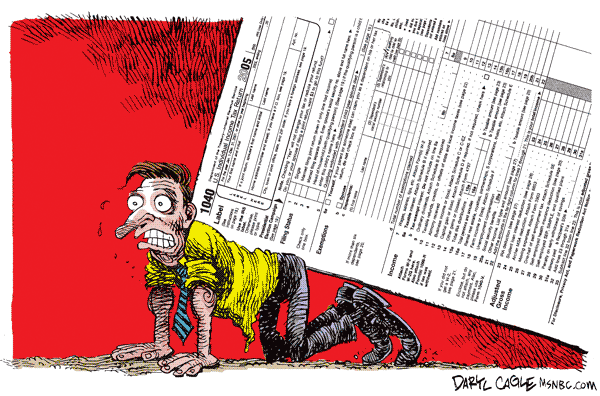

Posted in Uncategorized | Comments Off on Our Tax Burden
Posted by taxguru on April 15, 2006
Courtesy of The Late Show:
Top Ten Reasons I Love Being An Accountant
10. CPA training ensures I’m cool in high-pressure situations, like calculating the tip at Applebee’s.
9. While other poor losers go off to work in jeans and sneakers, I get to wear a suit.
8. You haven’t lived until you’ve filled out form 3277.
7. What can I say? I’m an adrenaline junkie.
6. I’m on such good terms with the IRS, I haven’t paid taxes since ’89.
5. I like to lick the envelopes.
4. Like the president, I only work one month a year.
3. After April 15th, I spend the year eating Pringles and watching rasslin’.
2. Women don’t expect much in the bedroom.
1. I fudge a couple of numbers and the next thing you know they’re hauling Letterman’s ass off to prison.

Posted in Uncategorized | Comments Off on Letterman’s Tax Day Top Ten
Posted by taxguru on April 14, 2006
For obvious reasons, Andy Roth over at The Club For Growth has been compiling a list with links of various versions of George Harrison’s classic song. I’ve been sharing the ones I’ve posted, and Andy has been sharing the ones he finds, such as this one by the late great Stevie Ray Vaughan, which he found on this blog post. I know there are many other fans of the song out there; so this is a good chance to expand your musical library.

Posted in Uncategorized | Comments Off on TaxMan Songs
Posted by taxguru on April 14, 2006

(Click on image for full size)

Posted in Uncategorized | Comments Off on Make sure to use the correct line.
Posted by taxguru on April 14, 2006
Q-1:
Subject: sale of residence Tax Relief Act of 1997I was just reading your page on the sale of residence.If I read it correctly, there is no more deferral of gains on a sale of a residence. The only thing is a $250K exclusion. But what about the taxpayer that sells a residence with more than a $250 gain, and wants to buy another residence. He’s screwed. Under the old rules he could defer the gain, but under this new rule he can exclude $250, but the remaining $1 million is taxable. This isn’t tax relief.Did I read this correctly?
A-1:
You read that correctly.
As with most things in life, the tax code is based on trade-offs. The multiple exclusion of gain was considered to be worth more than the previous gain deferral rule.
As for bumping up the amount of excludable gain, which hasn’t changed one bit since the law was enacted in 1997, there is little to zero chance of that happening. Our society has an insidious under-tone of envy and hating the evil rich is a full time task for the DemonRats and their propagandists in the media. This means that expecting any sympathy for having to pay tax on profits above $250,000 is a waste of time.
Obviously, the “fair” thing would be to allow people to choose between the tax free exclusion or the gain deferral by reinvesting into a more expensive home. Unfortunately, as I always have to point out, the concept of “tax fairness” is a huge oxymoron in this country.
If your sale hasn’t already closed, you should work with a tax pro to see if there is another way around having to pay tax on your gain. One common strategy is to convert the home to rental and dispose of it as a 1031 exchange for new rental property or properties and then later on, convert one of the replacement homes to personal use. The rules for this are tricky; so working with an experienced tax pro is critical.
Good luck.
Kerry Kerstetter
Q-2:
Mr. Kerstetter,Thanks for your response. I was thinking the same thing, regarding a conversion and 1031 exchange. I guess you could refinance before you convert, to pull out some equity, then use that cash to help you buy another residence.The problem I’m thinking of is my old mother’s residence that has much more than a $250K gain in it. Maybe I could convince her to sell it now, and exclude $250K of gain. It would seem to be better than the estate selling the property at her death and have the entire gain be taxable. She could rent it back if she wanted to stay there.
A-2:
You and your mother really should be working with estate planning CPA and attorney to work out the best game plan for her.
Depending on the size of her estate, it is entirely possible that her residence would not be taxable. Under current law, the heirs receive the property at its stepped up market value as of the date of death. This means that the heirs can literally turn around and sell the property shortly after and their is no gain. The only real potential tax to worry about is the estate tax, if the net estate is more than the excluded amount for the year in which she passes away. I have the current schedule of those exemptions on my website.
If our rulers don’t get off their butts and address the estate tax issue in the next few years, there will be a change in the step-up limits for estates created in 2010 and beyond; so no estate plan is perfect for long-term.
A good tax advisor could even help you come up with other options to take advantage of the current tax laws. One I have seen used is to sell the home now, with a large carry-back of the sales price. After deducting the $250,000 tax free exclusion, the remaining gain is reported on the installment plan, taxable as payments are received. That also allows for additional estate and income tax planning opportunities if the note receivable is left to the buyer of the property, such as a child.
There are several options available, which any experienced tax pro should be able to work with you on.
Good luck.
Kerry Kerstetter
Follow-Up:
Thanks for the info. I had forgotten about the stepped up basis. I must be losing it in my old age. For 18 yrs I was a Revenue Agent.She set up a family trust, so she’s in pretty good shape that way. The only problem is the exclusion amount, which she is probably a little under right now, but might exceed before the next exclusion kicks in, especially if real estate prices continue increasing.Thanks a lot for your help.

Posted in 1031 | Comments Off on Home Gain Above Exclusion LImit


 Tax Guru - Ker$tetter Letter