Archive for April, 2006
Posted by taxguru on April 10, 2006
Q:
Kerry,
The article you posted at your site was very helpful and educational… and I wanted to thank you for taking the time to post it. I need some clarification on something. I am about to sell my primary residence in Dallas. My profit is around $20K. I’ve only lived in this house for 8 months. Do I have to pay captical gains on this $20K even if I roll it into the purchase of a new house? Any other suggestions to avoid the capital gains tax? Thanks.
A:
It looks like you need to work with a professional tax advisor because I thought I had both of those issues explained fairly clearly on my website.
What you do with the money from your sale has absolutely no bearing on the taxability of the sale.
The only way you will be able to exclude the gain is if the reason for your sale so soon after its purchase is due to a health or employment reason or other unforeseen circumstance.
You should do a thorough accounting of your cost basis in the home, including all capital improvements. The higher the cost basis, the lower your profit, which is also reduced by selling costs.
None of this is very complicated, so pretty much any tax pro should be able to help you.
Good luck.
Kerry Kerstetter
Posted in Uncategorized | Comments Off on Selling Residence After 8 Months
Posted by taxguru on April 10, 2006
Q:
Subject: Filing as a “S” Corporation
Good morning!
I just completed my tax filing for 2005 as a sole propriotor. My accountant suggested I become a “S” Corporation. I made $70,000 last year but after expenses made $20,000. I am paying $3899 to the Federal Government and $78 to the State.
My accountant said “not” to file as a “C” Corporation. Can you give me more information?
Thanks,
A:
There is no one size fits all for deciding which entity type is best for a particular situation.
Your accountant should be able to explain why s/he decided that an S corp is best for you, including addressing the various issues that I mentioned in my article on the differences between C and S corps.
If your accountant just blindly decided that an S was right for you because s/he always chooses S corps (as some tax pros do), it’s time to find a new tax advisor who will take the time to properly analyze your situation before reaching a decision. Such an analysis should not be done unilaterally by the accountant and should include a lot of questions of you and any other people involved in your business. In a way, it’s similar to a doctor prescribing medication. That can’t be done without a thorough diagnosis of the patient. Same thing for structuring a business.
Good luck.
Kerry Kerstetter
Posted in Uncategorized | Comments Off on Choosing S Corp Status
Posted by taxguru on April 9, 2006

(Click on image for full size)
Posted in Uncategorized | Comments Off on
Posted by taxguru on April 8, 2006
Posted in Uncategorized | Comments Off on Specialized Scale:
Posted by taxguru on April 8, 2006
Q:
Subject: capital gains
If my parents put their home in a realty trust in 2004 and they passed away and the gain on the sale of the house is $600,00 do I get a stepped up basis as of the time of their death or does that fact that it is in a realty trust change that?
A:
You are going to need to consult with someone who can analyze the specific facts more closely because there are many different kinds of trusts. If it is a QPRT (Qualified Personal Residence Trust), there are different consequences depending on how long the trust was established for. In some cases, the basis does get stepped up, while in others it remains the same as it was for your parents.
You can get a flavor for how complicated this can be by Googling for QPRT, such as in this article.
I would think that you could probably get a good answer by consulting with either the attorney who set up the trust or the accountant who has been keeping the books and preparing the tax returns for the trust, if it is one of the types that requires annual income tax returns.
Good luck.
Kerry Kerstetter
Posted in Uncategorized | Comments Off on Homes In Trust
Posted by taxguru on April 8, 2006
Q:
Subject: S corps
Just read your article – have a couple of questions.
1. Can an S corp own another S corp with the second S corp having addl shareholders?
2. Is there an S corp structure that does not allow addl stockholders. For instance – you have an S corp -as an S corp another entity is purchased – can the addl entity have additional owners or must they be the same as the parent S corp. The purchased entity not being an S Corp.
I guess both of these questions are basically the same. What I have is an S corp for sale, possibly being purchased by another S corp…..the stockholders of the purchasing S Corp have indicated they CANNOT have other stockholders for just the new purchase. It has been indicated that the purchasing S corp is some special type of S corp….
Anyway – any information would be helpful.
Thanks!
A:
This is most definitely a very complicated area where a professional tax advisor should be involved.
There are ways for an S corp to own another S corp as what is called a QSub (Qualified Subchapter S Subsidiary). You can check IRS Form 8869 and see what is involved.
Good luck.
Kerry Kerstetter
Posted in Uncategorized | Comments Off on S Corp Subsidiaries
Posted by taxguru on April 7, 2006
From WSJ’s free Startup Journal:
The Benefits Of Incorporation – Would anyone want to work with a CPA who would make the following bone-headed comment?
That said, don’t fool yourself into thinking you’ll reap any major tax benefits from incorporating, says Robert Caplan, a certified public accountant in Foster City, Calif. Tax liabilities for corporations are generally the same, and sometimes even much higher, than those of a sole proprietor or partnership. “I hear people all the time talk about tax benefits of incorporating, but they’re just not there,” Mr. Caplan says.
Formalizing Loans From Relatives, Friends – It really helps to support the deduction for an unpaid loan if there is proper documentation. Otherwise, IRS likes to consider it a nondeductible gift, which is their beginning assumption for any money given between friends and family members.
Avoiding Pitfalls When Partnering with a Friend – Just like a pre-nup with marriages, terms of a business relationship should be well documented while everyone is on good terms. To skip that step is just asking for an expensive mess later on.
Posted in Uncategorized | Comments Off on
Posted by taxguru on April 6, 2006
Posted in Uncategorized | Comments Off on Adding more stress to Tax Season:
Posted by taxguru on April 6, 2006
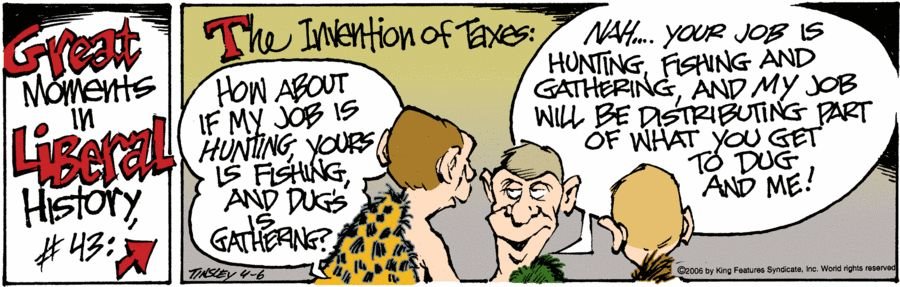
From Mallard Fillmore:

(Click on image for full size)
Posted in Uncategorized | Comments Off on Invention of Taxes
Posted by taxguru on April 6, 2006
Posted in Uncategorized | Comments Off on







 Tax Guru - Ker$tetter Letter