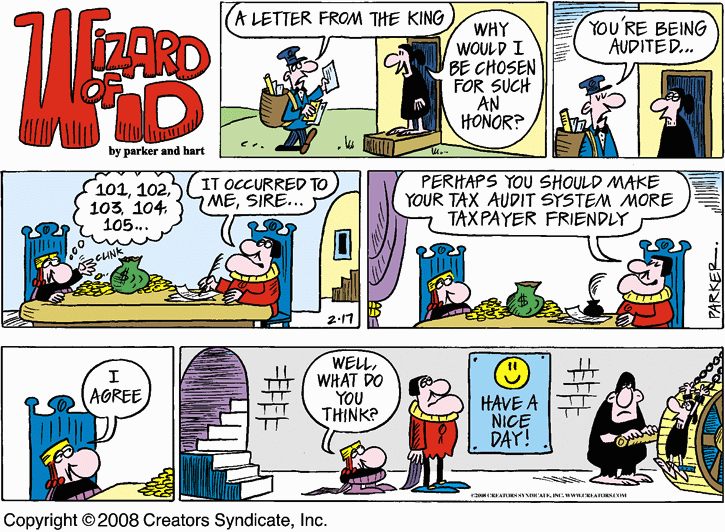
(Click on image for full size)


Posted by taxguru on February 22, 2008

(Click on image for full size)

Posted in Charity, comix | Comments Off on Documenting non-cash donations…
Posted by taxguru on February 21, 2008
From last night’s Tonight Show, as quoted by NewsMax:
This week on TV, John McCain said, “No new taxes.” You know who else said that . . . Wesley Snipes.


Posted in humor | Comments Off on
Posted by taxguru on February 20, 2008
Q:
We owned our home for more than five years and had it rented until 9/1/05 when it become our primary residence? The IRS is asking us how many days we lived in California? Before I put the answer on my tax form I would like to know if we spent approximately tow month traveling to our second home in Texas will it disqualify us for the exclusion? We had to sell the home because of financial reasons. This property become our primary residence on 9/1/05 to 11/8/07. We had all our mail there, utility bills, bank accounts and registered to vote. Thank you for your help as I am worried about this.
A:
You really need to be working directly with a tax pro to make sure everything is handled properly rather than trying to work through the rules on your own.
You are obviously trying to see if you qualify for the ownership and occupancy test of two out of the previous five years in order to be able to qualify for the full tax free exclusion. You seem to be confused as to whether visiting your second home doesn’t allow you to count that time as part of your time in the primary home.
As any competent professional tax advisor should be able to tell you, the occupancy rule doesn’t require that you actually be physically present in that house for 24 hours of every single day or even every single day that you are counting. Real life for most people does include time spent away from their main home for various reasons, be they business, medical or purely personal. As long as your primary residence is still considered your main base of operations, time you spend away temporarily at another location, including your own second home in another state, shouldn’t count against you. As long as you don’t take any of the steps to change your official primary residency away from the one you have had, you should be able to count that time as part of your ownership and occupancy.
Besides dealing with this issue, you will also need the assistance of a good tax professional to help you calculate the proper adjusted cost basis of your old home, including adjusting it for deprecation, to see if the exclusion will be enough to cover your paper gain.
Good luck.
Kerry Kerstetter
Follow-Up 1:
Thank you for your reply. I will contact a CPA and have him do our taxes. I appreciate your advise. The only reason that I became paranoid is the form ask” how many days did you spend in California.” We spent two years less about 90 days that we spent in our second home.
Follow-Up 2:
Thank you for your time in answering my question. I have made an appointment with a CPA.
Sincerely,


Posted in 121 | Comments Off on Counting days occupying primary residence…
Posted by taxguru on February 19, 2008
From WebCPA:
McCain Makes No-New-Taxes Pledge – We know how well these kinds of pledges work out in the real world of DC. Given McCain’s well known desire for Ted Kennedy’s approval, this promise will be broken so much faster than George Bush 41 reneged on his famous “read my lips” vow that it will be ridiculous.
From Nolo Press:
Top Tax Deductions For Your Small Business
Understanding Small Business Tax Deductions
Preparing for a Business Audit


Posted in Uncategorized | Comments Off on
Posted by taxguru on February 18, 2008


Posted in comix, taxes | Comments Off on Becoming a target for taxes?
Posted by taxguru on February 16, 2008


Posted in comix | Comments Off on Tax change, Huckabee style?
Posted by taxguru on February 15, 2008
Q:
Subject: Exchange Question
Will I invalidate the 1031 exchange if I don’t use all the money held in escrow to buy replacement property?
A:
Not reinvesting the full amount of your disposal leg proceeds won’t invalidate the 1031 exchange if everything else has been done properly.
However, it will, in most cases, not allow you to roll all of the gain from the original property into your replacement property. The actual calculation for the Form 8824 worksheet is a little messy; but the quick and dirty way to look at is that the unreinvested funds will be taxable in the year that you receive them. For example, if your disposal leg happened in 2007 and the 180 day reinvestment period expires in 2008, and you are sent the remainder of the funds in 2008, the taxable portion of the gain will be shown on your 2007 tax return as a deferred installment sale, with the actual gain subject to tax on your 2008 tax return. If both ends of the exchange happened inside the same tax year, the unreinvested potion will be subject to tax on that year’s tax return.
The tax rate that the unreinvested funds will be hit with will be the highest rate applicable to the property’s disposal. This normally works out to be the 25% Federal depreciation recapture rate, plus the comparable state rate, if you or the property are located in a taxable state.
I hope you’re picking up on the fact that the actual tax calculations are very tricky and are not something you should even think about attempting on your own. The services of an experienced professional tax preparer will more than pay for themselves in a case like this.
Good luck. I hope this helps.
Kerry Kerstetter


Posted in 1031 | Comments Off on Unreinvested Exchange Proceeds
Posted by taxguru on February 15, 2008
Q:
Subject: Question about security deposit and 1099
We (the tenant) just received a 1099 for a refund of our security deposit (office space that we rented) from a previous landlord. It is my understanding that security deposit is not income to the landlord when received nor to the tenant when returned to the tenant. It would only convert to income if it is forfeited and that would be income for the landlord not the tenant. Can you point me to some printed verification of my thought or tell me I am incorrect?
Thanks for your time
A:
How landlords treat the handling of security deposits is optional.
One way (and the technically correct way) is to book it when received into a liability account and not as income. If it is later forfeited by the tenant, it is transferred from the liability account into the Rent Income account. If it is repaid to the tenant, the check is posted to the same liability account as the deposit was and would thus not be a deduction from current year income.
Since that is a little too complicated for many people to keep track of, what is more commonly done in real life is for the landlords to use a more pure cash basis of reporting rental income and expenses. Under this method, all monies received, including potentially refundable security deposits, are reported as rent income in the year received. Any security deposits refunded to tenants are then deducted as expenses in the year paid out.
As long as the security deposits are handled consistently under whichever method the landlord chooses, things will be fine.
This only applies to money specifically designated as security deposit and does not apply to any money paid by the tenant which is specified as Last Month’s Rent. That is taxable income to the landlord in the year it is received, even though the last month could be several years away.
Here is an excerpt from Page 7-5 of the latest edition of The TaxBook, a reference source any good tax pro should have:
“Security deposits. A security deposit is not included in rental income when received if the property owner plans to return it to the tenant at the end of the lease. If any amount is kept during the year because the tenant did not live up to the terms of the lease, include that amount as rental income. If an amount called a security deposit is to be used as a final payment of rent, it is advance rent and is included as income in the year received.”
It seems like your landlord is probably using the second method of accounting for security deposits on his tax returns and is planning to claim the refund as an expense on his current tax return.
As your own personal professional tax advisor will most likely confirm, your treatment of the refunded security deposit on your tax return will need to be consistent with how you accounted for the original payment of that deposit. If you followed proper accounting methodology and booked it into an asset account on your books, the refund will be posted to that same asset account and will not be income to you.
If, on the other hand, you deducted that payment as a rent expense, you will need to pick up the refund as either income or a reduction of the current year’s rent expense. The latter would be the proper way to handle a refund of a previously deducted expenditure.
I hope this helps. Your own professional tax advisor can give you more specific advice on this matter.
Good luck.
Kerry Kerstetter


Posted in Uncategorized | Comments Off on Refunded Security Deposit


 Tax Guru - Ker$tetter Letter