Tax Guru – Ker$tetter Letter

Helping real people win the tax game.

  • Enter your email address to subscribe to this blog and receive notifications of new posts by email.

    Join 690 other subscribers
  • Blog Stats

    • 330,031 hits
  • Posts By Day

    February 2008
    M T W T F S S
     123
    45678910
    11121314151617
    18192021222324
    2526272829  
  • Subscribe

  • Special Pages

Archive for February, 2008

Amortizing Loan Costs

Posted by taxguru on February 15, 2008

Q:

Subject: Amortizing the cost of acquiring a mortgage

Hello Kerry:

Thank you for providing such wonderful information.

My question is rather simple.  I acquired rental property in 2007 and want to amortize the loan costs.  I understand how to calculate the amortization and that it is reported on line 18 (“Other”) of schedule E.  However, since I acquired the property (and mortgage)in 2007 I need to file Form 4562.  The amortization is done in Part VI of the form and everything is fairly straightforward except for 2 things. 
1) What do I list in column (d) – “Code section”?

I’ve searched the IRS site and the intranet high and low but can’t seem to find any information on this.  Form 4562 instructions list some codes, am I to use one of them?  The only one that seems to make sense is Section 197 – Certain intangibles.

2) If I put “Property A loan origination costs” as a description, can I use a 5 yr amortization like you suggest?  If I use code 197, am I stuck with a 15 yr term?

Thank you.

A:

When I enter a new loan costs item into the Lacerte depreciation schedule, I always choose Code Section 461 – Points as the appropriate amortization code section and manually enter the number of years that is appropriate for that particular item.  I’ve been doing that for over 20 years in Lacerte and IRS has never once had any problems with it; so that should work for you.

Kerry Kerstetter


Posted in Uncategorized | Comments Off on Amortizing Loan Costs

Multiple Vehicles For Sec. 179

Posted by taxguru on February 15, 2008

Q:

Subject: section 179 limits

Hi Tax Guru:

I have just finished reading the 179 entry on your website. Quick question, as a small business owner, can I purchase a new 6000 lb suv every year to qualify for the $25K deduction?


A:

Of course you can, if you want that many SUVs.  I used to have a client who traded in his car every six months for a brand new one.

As I’ve discussed numerous times, there are tax consequences to the way in which the old SUV is disposed of; selling vs. trading.

Your personal professional tax advisor can give you more specific info for your unique situation.

Good luck.

Kerry Kerstetter


Banner HPage_468x60


Posted in 179 | Comments Off on Multiple Vehicles For Sec. 179

Reasons for C or S Corp

Posted by taxguru on February 15, 2008

Q:

Subject: Confusion…

Kerry – Thanks for having your webpage! I found it very interesting reading. Unfortunately, I’m still wondering if I’m doing things correctly.

Suspect some background would be good:

I’m divorced, and paying child support (for another 5-6 years), and alimony. My wife had legal access to my 1040’s until now (that has ended in 2008 without a court order).

I’ve remarried to a legal resident, but non-US citizen (think thats relevant to S-Corp designation?). We formed a C-Corp in late 2006 to deal with single family home rentals we were interested in doing. Since then, we have grown to 6 homes in the area. Someday we would like to own 10, but no more. All are mortgaged in my name, since personal mortgage rates are WAY lower than Corporate mortgages. The C-Corp is the public interface that manages the property, accepts rental payments, pays the mortgages, reimburses travel expenses, etc.

At 10 homes, this company MAY generate $5000/month in profits in perhaps 10 years – and will be losing money or barely breaking even for some time. It was our plan to simply pay my wife a salary to drain that income from the company.

I am wondering if I should convert this C-Corp into an S-Corp, or LLC, in order to simplify accounting. e.g. Turbo-Tax handles rental properties well… and Intuits Rental Property Manager can feed Turbo-Tax directly. This would reduce (eliminate) my dependence on a local CPA that if a MAJOR expense ($150/hr and he loves to try and verify every transaction that occurs in the year, running up the total bill).

Any suggestions?


A:

There are far too many options to consider and possible scenarios that can be used to achieve your goals for me to even begin giving you specific advice via this medium.  You will need to work directly with an experienced tax pro who can analyze your unique circumstances.

I wish I could be more help; but I already have too many clients to take care of properly; so we are still trimming back on the difficult clients and are not accepting any new ones at this time.

Unfortunately, we don’t have anyone specific to whom we could refer you. I did recently post some names and links for some like-minded tax pros around the country.  

If you haven’t already done so, you should check out
my tips on how to select the right tax preparer for you.  You should note that geographic location should not be the main criterion for selecting a tax pro.

I do want to caution you from making these kinds of decisions based on your tax and accounting fees.  That is a very short-sighted approach to this kind of thing.  For example, I have plenty of clients with corporations whose annual charges are at least a thousand dollars more each year than they would be if we only had to prepare an annual 1040. However, I know for a fact that in almost every one of those cases, the proper use of their corporations allows them to reduce their overall tax bill by anywhere from $10,000 to as much as $50,000 each year.

I have long advised that there are what I call nuisance factors in having to keep separate books and file separate tax returns for corporations.  Only you can decide how much those factors are worth in dollars and cents.  However, for most people, spending a little extra time and $1,000 more in professional fees in order to save well more than $10,000 in taxes each year makes the nuisance factor seem quite affordable.

As I’ve constantly warned, there is no one size fits all in terms of the proper entities to use.  C corps do have a lot of tax savings opportunities if you work with an experienced tax professional.  Either way, if you were to use an S corp or an LLC, you would still need to keep separate books and file special income tax returns for them; so I don’t see how that should be much of a factor in your decision process.

Also, as I’ve warned for decades, if you think any tax software, whether it’s the consumer oriented TurboTax or the extremely expensive professional Lacerte software that I use, can take the place of a good tax pro, you are dangerously mistaken.  Nowhere is the adage of garbage in, garbage out more appropriate than with tax software.  Saving a few hundred dollars by trying to prepare your own tax returns is insane. Any good tax person will save you much more in taxes than his/her fee, as well as give you more protection against screwing things up on your own.

I’m sorry to be so blunt; but these points needed to be made.

I wish I could be of more assistance; and I wish you the best of luck.

Kerry Kerstetter


Follow-Up:

Appreciated Kerry - I'll go surf your section on selecting a tax preparer.

Thanks,


Posted in corp | Comments Off on Reasons for C or S Corp

Quick Summary of New Tax Law

Posted by taxguru on February 14, 2008

The folks at the increasingly useful TaxCoach software have just produced the following handy and concise summary of the new tax law that can be automatically personalized for clients set up on their system.

Economic Stimulus Package Offers Business Tax Cuts

President Bush has just signed a $168 billion stimulus package to prop up the economy and help prevent a recession. News reports have focused on tax rebates for individuals. But you may not realize that the package includes generous incentives for buying business equipment as well.

Want more cash in your pocket? The new law reduces the 10% federal tax bracket to zero for 2008 — then delivers the savings now in the form of rebates ranging up to $600 for unmarried individuals, $1,200 for married couples, and $300 per child up to a maximum of $600. This break phases out for incomes above $75,000 ($150,000 for joint filers).

The new law also gives you a 50% bonus depreciation deduction for new equipment you buy for your business in 2008. It raises the Section 179 first-year expensing limit from $128,000 to $250,000. And it doubles the phaseout for Section 179 deductions from $400,000 to $800,000. This is great news if you’re planning to buy vehicles or equipment for your business, or even to renovate business premises.

This is a special, limited-time break, so before you buy new equipment, be sure to call us.


TaxCoach Software: Finally! Plain-English Tax Planing That Builds Your Business! 


Posted in NewTaxLaws | Comments Off on Quick Summary of New Tax Law

Sec. 179 For Vehicles

Posted by taxguru on February 14, 2008

Q:

Subject: Section 179

My wife is currently are using the standard mileage deduction on a Chevy we transferred into business service 4 years ago.  We are expecting a large tax liability this year and next year my wife is taking off 3 months from her LCC business (she uses schedule C for business income) so we want to take the section 179 depr deduction this year.

If we buy the car on 12-31-07 and put it into service that day, it will be used 100% this year for the business.  The existing vehicle (which will be traded in with a $10,000 trade value) will have about 75% business.  Can I still claim 100% of the 179 deduction on the new SUV?

If next year the business use drops to 75% is there any recapture requirements or does that only effect next years actual cost deduction?

Finally, any problem with using both the standard deduction on the old vehicle for 2007 (it will be taken out of service on 12-28-07) as well as using the 179 deduction for the new car?  The cost of the new car is $45k, with the trade in my cash loan is $35k so I have $10k for deprecation, would I use the 30% or 50% method going forward in future years for the $10k left to deduct using the actual method?

Is the trade still considered like kind even though I changed deprecation methods?

I know this is late in the season, but we are making the purchase, now we have to decide how to handle the tax issues.

Thanks


A:

You really need to be working with a professional tax advisor on matters such as this rater than trying to stumble your way through the tax maze on your own.

Just some quick answers to your main queries.

There is no actual Section 179 or deprecation recapture required in subsequent years unless the business usage percentage drops below 50% or the asset is sold.  If you claim 100% business usage for 2007 and then the business usage drips to 75% in 2008, the 2008 depreciation deduction will most likely be zero, depending on how much of the purchase price you are expensing for 2007.

The numbers you gave are a little confusing.  Basically, the amount eligible for Section 179 expensing is the excess of the new vehicle’s purchase price over the trade in allowance you are given.  For example, if the new vehicle is costing $45,000 and the dealer allows you a net of $10,000, the extra $35,000 is available for the Section 179, subject to the various other limits.  If there is a pay-off or assumption of an old loan on the old vehicle, the calculation changes, with a lower amount being available for Section 179.

Any undepreciated cost of the older vehicle would continue to be depreciated over the life of the new vehicle.  Since you have been using the standard mileage method, you will definitely need to have a professional tax advisor do the basis calculations on the old vehicle, the like kind exchange worksheet and form (8824) and the new basis of the replacement vehicle.  Like kind has to do with the vehicle for vehicle and the fact that you are going to be using different deprecation methods for the new vs old one doesn’t have any bearing whatsoever.
 
Again, you should be able to see that this can get very messy on your 1040 and you definitely need to be working with a tax pro who can see that everything is reported properly.

Good luck.

Kerry Kerstetter


 TaxCoach Software: Are you giving your clients what they really want?


Posted in 179 | Comments Off on Sec. 179 For Vehicles

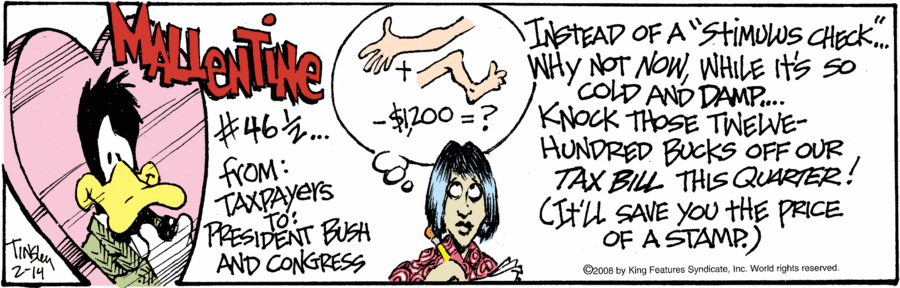
A better rebate plan?

Posted by taxguru on February 14, 2008


(Click on image for full size)

Posted in comix, Rebates | Comments Off on A better rebate plan?

Breaking even?

Posted by taxguru on February 13, 2008

Posted in comix, TaxCuts, TaxHikes | Comments Off on Breaking even?

IRS to Tighten Enforcement of Like-Kind Exchange Rules

Posted by taxguru on February 13, 2008

Courtesy of the most recent email bulletin from ACAT.

If you are considering a like-kind exchange (also known as a Section 1031 or Starker exchange), you need to review the IRS regulations that apply…and do it right.


Like-kind exchanges allow investors to defer taxes when they dispose of property they currently own and replace it with similar property.  However, the Internal Revenue Service plans to increase audits and enforcement of these exchanges beginning mid-2008.


Usually when a business or investment property is sold, the seller must pay tax on any profit.  The tax varies depending on the type of income and the current tax rate.  For example, if you purchased land for $100,000 and sold it for $200,000, you could expect to owe $15,000 federal income tax on the transaction, assuming a current capital gains tax rate of 15%.


With a like-kind exchange, it is possible to purchase property for $100,000, sell it for $200,000, buy another like-kind property for at least $200,000, and avoid income taxes on that sale.  But you have to follow the IRS rules precisely, and this requires planning prior to the transaction.


First, the property sold and the replacement property must be “like-kind.”  IRS rules and regulations offer guidance to help determine what qualifies as like-kind property.  For example, you can exchange a single-family home for an office building, or an apartment complex for a shopping center. But you can’t exchange your home for an oil well and you can’t exchange real property for a business. 


Second, many like-kind exchanges will require the assistance of a qualified intermediary in order to comply with all of the requirements for a tax-free exchange.  You can usually find a qualified intermediary in your area by checking the Yellow Page listings under “Title Companies.”


All like-kind exchanges must be reported to IRS by filing Form 8824 with your federal income tax return.


Sounds confusing?  Studies by the IRS and the Government Accounting Office have found consumers don’t understand the rules.  But help is on the way.


The IRS has updated Publication 17 “Your Federal Income Tax” to better tell taxpayers about like-kind exchanges.  Additional information about the like-kind exchange process is found in IRS Publication 544 “Sales and Other Dispositions of Assets,” and in the instructions for Form 8824.


There are significant savings you can realize. But the best advice is to get your accountant involved at every step.


This information is provided as a public service, and should not be construed as individual accounting or tax planning advice.  For information on how these general principles apply to your situation, please consult an accounting or tax professional.


Posted in 1031 | Comments Off on IRS to Tighten Enforcement of Like-Kind Exchange Rules

eBay Auctions and Garage Sales

Posted by taxguru on February 13, 2008

Courtesy of the most recent email bulletin from ACAT.

Did you hold a garage sale this year to get rid of excess “stuff”?  Or maybe you auctioned items on eBay…or started a home-based business of on-line auction sales?  The IRS has rules and guidelines to follow in reporting your income from these sales.


Did you sell a few personal items on eBay?

If you auctioned a few personal items on eBay and the sale price was less than what you paid for the item (or its depreciated value), you generally do not have to report this income on your tax return.


Did You Have an Online Garage Sale?
If your online auction sales (eBay or some other online service) are the Internet equivalent of an occasional garage or yard sale, you generally do not have to report the sales. In a garage sale, you generally sell household items you purchased over the years and used personally. If you sell the items for less than you paid for them, the sales don’t have to be reported on your tax return. Losses on personal use property are not deductible, either. However, see below for gain reporting.


Did You Sell Appreciated Assets at an Online Auction?
An “appreciated asset” is something that has increased in value with the passing of time.  Examples of appreciated assets often include art, antiques and collectibles. If you have online auction sales of property where the sales price is more than your cost, you usually will have a reportable gain. These gains may be business income or capital gains.


Did You Start a Home-Based Online Auction Seller Business?
If your online garage sale turned into a business and/or you have recurring sales and are purchasing or producing items for resale with the intention of making a profit; you may have started an online auction business.  The sales of these items must be reported on your income tax return.


Are Your Online Auction Sales a Business or a Hobby?
If you regularly purchase or produce items to sell online, you must report the income on your income tax return.  How you report that income depends on whether your online auction sales are considered a “business” or a “hobby.”  The factors to consider in making this determination are discussed at length in IRS publication 535.  In summary, the activity is a hobby if it is done primarily as a recreational activity without a distinct profit motive.  The activity is probably a business if it is carried on in a businesslike manner with a clear profit motive. 


If your online sales constitute a business, the income is reported on Schedule C, Profit or Loss from a Business.  Allowable business expenses are also listed and deducted on the Schedule C, so that only the net profit or loss is included in your adjusted gross income.    


If your online sales are a hobby, your expenses can not exceed the income from the activity, i.e. you may not show a loss.  You may not deduct any expenses at all unless you itemize your deductions on schedule A of your tax return.  In addition, your expenses may be reduced by a percentage of your income. 


Did You Sell Depreciated Business Assets?
If you sell business assets or close your business, you may have capital gains, ordinary gains and depreciation recapture to report. An example is the sale of an automobile used for business.


If you have questions, see your tax professional for details and instructions on your specific situation.


This information is provided as a public service, and should not be construed as individual accounting or tax planning advice.  For information on how these general principles apply to your situation, please consult an accounting or tax professional.


Posted in Uncategorized | Comments Off on eBay Auctions and Garage Sales

Charitable Gifts – Still Deductible, But You Must Have Proof

Posted by taxguru on February 13, 2008

Courtesy of the most recent email bulletin from ACAT.

If you are like most Americans, you make donations throughout the year.  Your schools, religious groups, museums, Salvation Army, Cancer Fund and many more non-profit organizations benefit from your giving.


The U.S. Congress recognizes the benefits of your generosity and has steadfastly maintained deductions on your federal income tax for charitable giving.  But this doesn’t mean that there aren’t regulations to be followed.  And the rules have gotten stricter for reporting charitable gifts on your 2007 tax return.


Donations of Cash

The good news: You are still permitted to take substantial tax write-offs for charitable contributions – as high as 50 percent of your adjusted gross income.


The old news: Charitable contributions of $250 or more require a specific written acknowledgment from the charity. 


The new (stricter) news: Any out-of-pocket cash donations you make without documentation cannot be deducted. No longer can you deduct cash dropped in the collection plate at church or synagogue.


The solution: Get a receipt for all donations.


All donations must be documented by a bank record (cancelled check or bank statement) or a written communication from the charity.  The documentation must include the name of the charity, the date of the contribution, and the amount of the contribution.


For contributions of $250 or more, you can deduct the contribution only if you have an acknowledgment of your contribution from the charity.  A bank record is not sufficient documentation for a donation of $250 or more.


Donations of Clothing and Household Goods

The good news: These donations are still deductible.


The hard to understand rules:  Experts are still working on how to interpret the language which reads, “to be deductible, clothing and household items donated to charity after August 17, 2006, must be in good, used condition or better.”  How does a taxpayer document the condition of used items?    One option: Consider taking photos.


The documentation required for deduction of a non-cash donation varies with the amount of the deduction.  If the deduction is less than $250, only a receipt from the charitable organization is required.  For a deduction of $250 or more, a written acknowledgment from the charity is needed.  If the deduction exceeds $500, detailed information on the items donated must be reported on your tax return.  For donations exceeding $5,000 in value, a qualified appraisal is required to support the valuation.  Recommendation:  For all non-cash contributions, keep an itemized detailed inventory of what you donate including cost, date bought, condition and current value.  Consider an appraisal or other means of documenting the value of expensive items that you plan to donate to charity.


In all cases: Consult your tax advisor for help with your specific situation.


This information is provided as a public service, and should not be construed as individual accounting or tax planning advice.  For information on how these general principles apply to your situation, please consult an accounting or tax professional.


<script language="'JAVASCRIPT1.1'"
src=”http://affiliate.softcom.biz/aw.aspx?A=172&G=16&Task=Get&Browser=N”&gt;


Posted in Charity | Comments Off on Charitable Gifts – Still Deductible, But You Must Have Proof