Kansas suspends income tax refunds – It’s not just the PRC pulling this scheme.


Posted by taxguru on February 17, 2009
Posted in StateTaxes | Comments Off on Dangerous trend with state tax agencies…
Posted by taxguru on February 17, 2009
From last night’s Conan show via NewsMax:
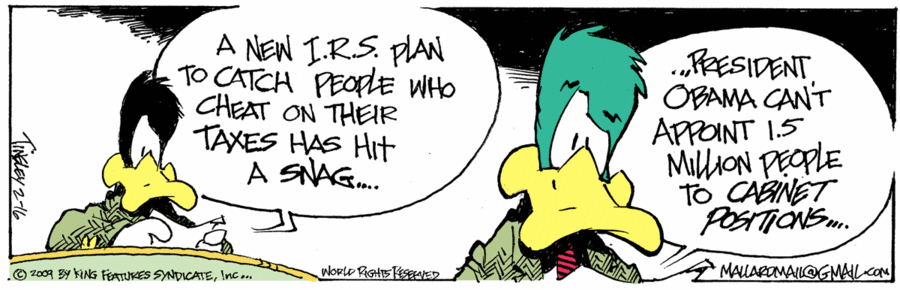
Yesterday, one of Obama’s top advisers said that choosing Cabinet members is not like picking American Idol. Yeah, mainly because “American Idol” contestants have paid their taxes.

Posted in humor | Comments Off on
Posted by taxguru on February 16, 2009
I was browsing the new additions to the always useful TaxTools program and noticed the worksheet they have for listing and valuing non-cash donations. It has suggested values for used items, making it easier to work with than having to refer to outside sources such as the Salvation Army’s guide.
I made up a blank PDF version of this worksheet that you can download from my site.

Posted in Charity, Deductions, worksheets | Comments Off on Non-Cash Donations Worksheet
Posted by taxguru on February 15, 2009
Many people just assume that they need to do a Section 1031 like kind exchange in order to save on their taxes. This decision may be premature if the taxpayers haven’t had their professional tax advisors run the numbers to see if an outright sale would in fact cost them anything in taxes.
I have seen many cases where people assumed that a sale would result in taxes, when in fact that wasn’t the case. Here are some of the most common reasons that a sale may not cost any actual taxes, starting with a new one that is just now starting to show up on tax returns.
Special Zero Percent Capital Gains Tax – For 2008, 2009 and 2010 sales by individuals, all or part of any long term capital gain is subject to a Federal tax rate of zero percent. The actual calculation of this is rather complicated and should be handled by your professional tax advisor’s tax software.
While this has the potential to save large amounts of taxes and thus make doing a 1031 exchange unnecessary, there are some other factors to consider.
This is for Federal purposes only and most states have not gone along with this; so there could still be State taxes on a sale.
This only applies to the long term capital gain portion of a sale. It does not apply to short term capital gains for assets held less than 12 months. It also does not apply to gain attributable to depreciation recapture, which is still subject to a 25% Federal tax rate plus the State tax rate.
The other key consideration is the political environment. The new president said during his campaign that he wanted to eliminate any special tax breaks for capital gains and make them subject to the same much higher tax rates for other kinds of income. He said that he is will aware that this will reduce the government’s revenues from capital gain taxes as more people take steps to avoid paying them; but he sees it as the Fair thing to do. He can’t do anything to affect the tax on 2008 sales, but he could repeal the special tax break for 2009 and/or 2010 sales as he has been promising/threatening to do.
Loss Carry-forwards – Many people have large losses that they have been carrying forward for several years on their tax returns that can be used to offset gains from the sales of business and investment properties. These carryover losses include Capital Losses, Net Operating Losses and Passive Activity Losses. There should be some kind of schedule with your latest tax return showing how much of these kinds of losses are being carried over into the current tax year. Similarly, your professional tax preparers should have those losses already set up in their tax return software when running proforma tax calculations of a possible sale.
Basis Mistakes – To determine whether you have a gain or loss on a sale, it is critical to understand the proper cost basis to use for the asset. One of the most common mistakes has to do with inherited property. The cost basis for the heir is the asset’s fair market value at the time of the previous owner’s death. This means that an inherited asset being sold shortly after it has been received will normally result in no gain, and possibly even a loss after deducting selling costs. Doing a 1031 exchange only makes sense if there is a profit to defer.
On the flip side, the other common basis mistake has to do with items received as gifts from living persons. In those cases, the cost basis to the recipient is the same as it was for the giver. While the actual receipt of a gift is tax free for the recipient, recipients are essentially accepting responsibility for future capital gain taxes on it. It is important that the giver provides the cost basis info to the recipient along with the gift.
As always, no tax oriented transaction, especially dealing with capital gains and 1031 exchanges, should be attempted before the numbers have been run by your professional tax advisor. Any fees they charge will be minimal compared to the potential tax savings.


Posted in CapGains | Comments Off on When you may want to show capital gains…
Posted by taxguru on February 14, 2009
Q-1:
Subject: Small Business asking for a little help or direction.
Dear Kerry,
I came across your website while researching corporate tax information and was very impressed with the information and your desire to limit tax liability.
I was hoping you could offer a little help on my businesses.
Last year I purchased 3 small businesses from a single owner. The businesses sell very similar products, but are run as 3 separate corporations. 2 are “C” corps and 1 is a “S” corp. All located in Chicago, IL. Combined total annual sales of $2.8 million for all 3 companies.
I hired a new accounting firm to review my financials, do tax planning and file annual tax returns.
They are strongly recommending I change the 2 “C” corps into “S” corps. To avoid the future possibility of “double taxation” on dividend payments and keep things simple by changing all 3 companies to a true calendar fiscal year.
Historically over the last 10 years these businesses have never paid dividends. So I don’t see the benefit. The previous owner managed expenses across the 3 companies to avoid paying excessive taxes and never paid himself dividends just a nice salary.
After doing some research on line and reading your web site I feel like I have received some very bad advice. I believe I need to find a new accounting firm that has my best interests in mind. Also, with the new administration coming in January I think keeping my income as low as possible on my 1040 will be more important than ever.
I want to aggressively manage the businesses to limit my tax liability and I need a financial firm who thinks the same way.
Can you kindly offer some advice on how to proceed.
I would love for you to handle my financials or provide financial advice.
Any advice, direction or referral you can offer would be greatly appreciated. Do you know of a good professional tax advisor near Chicago?
Thank you in advance for your time and response.
Thanks and Best Regards,
A-1:
You are correct in recognizing the fact that your current accountant is not looking out for your best interests. Unfortunately, there is no shortage of lazy short-sighted tax pros who try to force everyone into a one size fits all approach, often just using S corps.
As I have been preaching for decades, there are huge tax and liability saving opportunities by using multiple corps with different fiscal years. The ability to smooth income out and even multiply certain tax breaks, such as Section 179, can save huge amounts of money in taxes. As I have explained countless times, the big fear of double taxation is crazy. Any creative tax advisor worth his/her salt can find methods to shift income in ways that avoid the same money being taxed twice.
Using nothing but S corps for profitable businesses is completely counter-productive, especially in this environment. That puts everything onto your 1040. With the incoming administration in DC hyping the fact that they intend to soak people in the upper income levels, adding more income to your 1040 will just make you a more attractive and inviting target for more of your income to be confiscated and spread around. Unless you agree with that definition of being “Patriotic,” the goal for preserving more of your hard earned income should be to take steps to keep your 1040 income down as low as possible and slide under the radar of the Socialists who are now in charge of our lives.
I am still not at a point where I can accept any new clients; so you will need to keep looking for someone who will help you reduce your taxes instead of trying to structure things to make it easier on themselves, as it sounds like your current accountant is doing. You may want to start with the tax pro who helped the previous owner of the businesses because it sounds like s/he understands how to work with multiple entities in a tax efficient manner.
Unfortunately, we don’t have anyone specific to whom we could refer you. I did recently post some names and links for some like-minded tax pros around the country.
If you haven’t already done so, you should check out my tips on how to select the right tax preparer for you.
You should note that geographic location should not be the main criterion for selecting a tax pro.I wish I could be of more assistance; and I wish you the best of luck.
Kerry Kerstetter
Q-2:
Dear Kerry,
Thank you very much for your detailed response and advice. We are in agreement on the correct strategy for limiting taxable income for my businesses and on my 1040. I have begun a search for a new tax pro who will have my best interests in mind.
I greatly appreciate your comments.
Would it be possible to add my name to you waiting list of potential customers should you ever be ready for additional clients?
Please let me know.
Thanks again for your response.
A-2:
I will keep you posted if my workload ever allows me to accept any new clients. I do have several names already on the waiting list; so I will be very selective as to the criteria any new clients must meet.
One of the most important factors will be that they are already up and running with proper accounting on QuickBooks for each of their entities.
Good luck.
Kerry Kerstetter


Posted in corp | Comments Off on Mutiple Corps
Posted by taxguru on February 14, 2009
Q:
Subject: C or S corporation, no employees/partners
I am not sure if you reply to emails asking for additional advice, but I’ll give it a shot.
I am starting a marketing company in Ca. with no employees. (new babies, need money)
I do have a full time job, and this will be on the side.
>From your article a C corporation makes more sense for me.
But, I am scared of ticked off tigers, cobras, AK-47s, and the IRS.
Will I be asking for trouble if my company makes no money, and I decide to end the corporation in a year or so?
Does my separate tax return get red-tagged if I start a corporation that does/does not make money?
Thank you in advance for your time.
A:
You really need to be working with an experienced professional tax advisor to set up the best strategy for your unique situation.
A corp that only has losses doesn’t really attract a lot of dangerous attention from IRS; so that really isn’t a concern here. However, there are some other more important issues that you need to evaluate.
For example, I am wondering why you are so anxious to jump into the cost and hassle of setting up a corp right now. Most small businesses start off as Schedule C sole proprietorships and then evolve into a corp entity as they become more profitable.
Sole proprietorships cost nothing to set up or dissolve; unlike corps in Calif, which have a $800 minimum annual tax. Losses from Schedule C can also be used to offset other income on your 1040. While losses from S corps can be used to offset other 1040 income, C corp losses can’t do that.
Please consult with a tax pro before you take that expensive leap into a corp.
Good luck.
Kerry Kerstetter
Follow-Up:
Thank you so much for taking the time to answer my email Mr. Kerstetter, especially in these holiday times. I have taken your advice, and will be seeing a tax pro. ASAP to seek some advice in these matters.


Posted in corp | Comments Off on Setting Up Corp
Posted by taxguru on February 14, 2009
Q:
Subject: declaring bad loans
Hi
we have made some loans guaranteed by mortgages. However these are in different countries.
The amounts are quite large. Basically I have lost the money and the individuals are nowhere to be found. We are speaking in the hundred of thousands of dollars. the loans were securied by foreign real estate. The foreign country is Lebanon and in a semi state of war or civil unrest so it is hard to foreclose as well.
How can I take a deduction on my taxes. I have not declared the interest income. I am thining of filing a 1040 X for last year and declaring the interest income. Have not filed 2007 taxes this year and am getting ready to do so. I want to take a the bad loan deduction in 2008
Do not want the deduction to trigger an audit.
can you help.
A:
You need to be working with an experienced professional tax advisor to make sure you do things properly here.
Interest income that has accrued on the notes but hasn’t been received does not need to be reported as income on your 1040. However, if you did receive actual interest payments, those should be reported for the years in which they were received. If that is the case, you should file amended Federal and State income tax returns to correct that situation. You will have to pay the additional taxes plus interest, but IRS and most states will waive late penalties if you voluntarily disclose the under-reported income rather than wait for them to catch you.
Writing off investments as uncollectible and worthless can trigger an IRS audit if the tax return doesn’t include a lot of attached documentation as to why you have concluded that 2008 is the appropriate year it became completely worthless and how you calculated your unrecovered adjusted basis. IRS loves to disallow bad debt deductions for either being claimed too early or too late. A good tax pro can help you document the proper year to claim the loss. A good tax pro can also ensure that you are claiming the proper amount. A common mistake people make is to try and claim a bad debt loss for accrued but unpaid interest. That is not allowed.
Good luck. I hope this helps.
Kerry Kerstetter


Posted in Deductions | Comments Off on Deducting Bad Debts




 Tax Guru - Ker$tetter Letter