I will soon be posting another email exchange with a reader on Roth IRAs. In the meantime, here are some recent items from the free WSJ on them.


Posted by taxguru on January 6, 2009
I will soon be posting another email exchange with a reader on Roth IRAs. In the meantime, here are some recent items from the free WSJ on them.
Posted in Retire | Comments Off on Roth IRAs
Posted by taxguru on October 27, 2008
Q-1:
Subject: sep ira tax calculations
can profit distributions to an owner of an s corp. be used to calculate contributions to a sep ira?
A-1:
No it can’t.
Only earned income that is subject to Social Security tax is eligible for the SEP earning test. Since S corp net profit on a K-1 is not subject to any SS tax, it doesn’t count towards SEP-IRA eligible income.
Whether or not it makes sense for you to intentionally restructure your S corp income in such a way so as to pay in some SS tax and thus make it possible to use that income as a means of qualifying for a SEP-IRA contribution is something you need to work on with your professional tax advisor. It may or may not be counter-productive to do that.
Good luck.
Kerry Kerstetter
Q-2:
kerry can someone have a sep ira and a roth ira or any other retirement combination with a sep ?
A-2:
You can simultaneously have several types of retirement accounts. The tricky part comes in determining which ones you are allowed to contribute to each year.
Rather than ask me about each potential combination of plans, the more efficient approach would be to work with a professional tax advisor to run each of the scenarios until you find one that suits your unique situation and goals.
Good luck.
Kerry Kerstetter


Posted in Retire | Comments Off on Qualifying for IRAs
Posted by taxguru on June 20, 2008
Q:
Subject: Question about IRA’s
Hi Kerry,I have a friend who is a nurse at a hospital in Berkeley.She has two IRA accounts….one is noted as a 403(b)The other one has nothing to indicate what it is, so we are assuming that it is a traditional type IRA, tax defered account.Naturally both of her accounts are losing her money and she wants to roll-over both these accounts into some other tax defered plan. Both the broker(manager) and her human resources dept. are telling her that she cannot remove funds from either account until she turns 59 1/2 yrs old (this December). (assuming that she doesn’t quit her job)They say that taking either account to “cash” and mailing the money direct to the “new fund” would still be a taxable event because she hasn’t turned 59 1/2 yet.Actually….the manager said that she could take the 403(b) to another fund and she wouldn’t be taxed….and the HR Dept said that was wrong even transfering the 403(b) would be taxable.Since she isn’t quiting her job…..then there isn’t a “distributable event”…..YOU ARE THE GURU……PLEASE ENLIGHTEN US.Many Thanks,
A:
I’m not really a fan of second hand tax advice. Your friend really needs to work with her own personal professional tax advisor in order to work out the best plan for her unique circumstances. However, there are some good issues here that will make for an interesting blog post, so the following comments are more general than she really needs.
A 403(b) account is basically the non-profit equivalent to the 401(k) deferred compensation retirement savings account that many for-profit companies offer their employees.
What seems to be the confusion is the fact that there are very different rules for IRS in regard to what kinds of things would be taxable and the rules that are established by the administrator of the retirement accounts. In most cases, the paperwork that employees sign when enrolling in employer sponsored plans is much more restrictive in regard to withdrawals and loans than the IRS rules are.
Thus, I can only discuss the IRS rules with any confidence. She will have to review her plan documents to see what restrictions she has agreed to, such as not moving the money while she is still employed there.
For IRS, any person is allowed to roll over their retirement assets from any tax deferred account, such as 403(b) and conventional IRA accounts whenever the person feels it to be in her best interest. With a direct custodian to custodian transfer, the full amount is rolled over to the new account, without anything being withheld for income taxes.
However, if she were to take a check for the withdrawal, she has 60 days to roll it over into a new retirement account, or even multiple accounts if she feels it best to diversify. In this kind of situation, because there is no absolute guarantee that the employee will actually deposit the money into a new retirement account, IRS requires that the first custodian withhold 20% of the withdrawn amount and send it to them just like Federal income taxes withheld from paychecks. This amount can then be claimed as a credit on the person’s next 1040. The big problem that arises is that for a completely 100% tax free rollover, the person will have to use other funds to make up for the 20% that was withheld or else it will be considered a taxable withdrawal.
As an observation, I have noticed over the past few years a number of cases where clients doing withdrawals from their retirement accounts did not have any taxes withheld and were thus able to easily deposit the full amounts into their new accounts. For some reason, their old employers and/or plan custodians were being nice guys and ignoring the IRS withholding requirement, which isn’t always the case.
Rollovers of retirement accounts can be done at any age. Anyone claiming that only people over 59.5 years old are eligible for tax free rollovers is seriously ill-informed. The 59.5 years of age threshold is only important when taking out taxable withdrawals because if none of the exceptions applies, there will be early withdrawal penalties for both IRS and FTB.
So, in summary, IRS will allow a tax free rollover at any age. Any restriction on such a move would be in the plan’s governing documents. Her own professional tax advisor should review those documents to see if she did formally agree to such restrictions.
In similar cases I have seen, where someone has been locked into a money losing retirement account, the next best thing to a rollover is to stop any new contributions to it by amending her agreement with the payroll department and diverting that money into another retirement account, such as one of the IRA plans.
I hope this helps.
Kerry
Follow-Up:
Thanks Kerry,So as far as the IRS is concerned, she can “roll-over” her Tax defered IRA’s into new ones with a direct transfer into the new accounts. She will need to see if her current retirement funds have more restrictions, placed there by her employer, that would keep her from transfering at this time.Thanks so much,YOU ARE THE GURU !!


Posted in Retire | Comments Off on Rolling over retirement funds…
Posted by taxguru on January 27, 2008
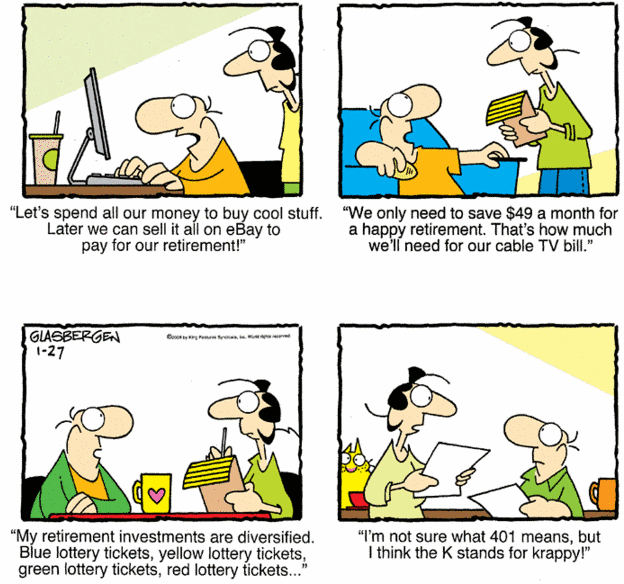
(Click on image for full size)

Posted in comix, Retire | Comments Off on Unorthodox retirement plans…
Posted by taxguru on January 10, 2008

Of course, a retirement account with $401,000 wouldn’t be too shabby.

Posted by taxguru on September 18, 2007
Q:
Subject: Fair Tax & Roth accounts?
How is the Fair Tax supposed to integrate with Roth accounts? These are *supposed* to be tax-free upon withdrawal. The Fair Tax represents a very large stealth tax increase on these accounts.
A:
There’s no way to make such a radical change in the tax system without also affecting the results of tax motivated transactions.
This is why I have always been critical of plans by people to convert conventional IRAs to Roths. Paying real tax money now for promised tax savings down the road has never felt like a good idea because there is no guarantee that the tax free aspect will survive the whims of our rulers in DC. While I do support the concept of the FairTax, I’m not as worried about it messing up Roth IRAs as I am about our rulers instituting a means test for taxation of Roth IRA income in the same way they did for Social Security recipients.
Thanks for writing.
Kerry Kerstetter
Follow-Up:
I did it because (a) I had relatively low tax cost since I converted during a year when I was unemployed, and (b) I won’t be making any more contributions to the account. You’re right about their tendency to take away what they have given when their lack of restraint catches up to them. I shudder at the thought of Hilary as President and a Democrat-majority Congress.A means test? That would be horrible! Of course, that wouldn’t raise the kind of revenue the IRS expects. The means test only screws middle-income taxpayers. Low income (though with non-indexed income thresholds this becomes progressively less meaningful) people won’t be affected, assuming they even have a Roth account, and people with plenty of non-Roth income won’t have to take distributions. To give means testing real sharp teeth you’d need to make Roth IRAs subject to RMD.

Posted in FairTax, Retire | Comments Off on Losing Roth IRA tax break?
Posted by taxguru on August 25, 2007
Q:
Hi Kerry,Can sold IRA asset profits be treated as long term capital gains for tax accounting if they are kept over the required time?(6months?)I have sold quite a bit this year and would appreciate your advice.Thanks….
A:
This is an issue that catches a lot people by surprise. While sales of assets held for more than 12 months in your individual or living trust’s name qualify for the special lower long term capital gains tax rates, that is not the case for gains made by investments inside IRA and other retirement accounts.
Conventional IRAs, where you claim a deduction for contributions made to the accounts, are tax deferred arrangements. When money is drawn out, and not rolled over into another retirement account, it is all subject to income tax as ordinary income regardless of how the money was invested inside the retirement account. Income generated from bonds or other interest bearing investments is taxed the same way as profits made from stock trades. So, keeping track of long term capital gains earned inside IRAs is not required for anything.
The other main kind of IRA, the non-deductible Roth, has the advantage of allowing completely tax free income from all of its investments, as long as the account has been held for at least five years. Just like with conventional IRAs, there is no need to keep track of what kinds of earnings were generated inside the IRA because they all receive the same tax treatment.
As you may have read on my blog on several occasions, I am still very skeptical of the long term tax free status of Roth IRAs. It is still my prediction that our rulers in DC will pull the same Switcheroo on Roths as they did with Social Security benefits, and force those they consider to be evil rich to pay tax on income receive from them. FYI: Evil rich for SS recipients is any single person earning over $25,000 or married couple earning over $32,000 per year.
I hope this answers your question.
Kerry


Posted in Retire | Comments Off on Taxing IRA Investments
Posted by taxguru on June 9, 2007
Using Real Estate to Build Your Retirement Portfolio – Using self directed IRAs to invest in real estate can be a much more reliable method of amassing wealth than gambling on the stock market.


 Tax Guru - Ker$tetter Letter