Tax Guru – Ker$tetter Letter

Helping real people win the tax game.

  • Enter your email address to subscribe to this blog and receive notifications of new posts by email.

    Join 690 other subscribers
  • Blog Stats

    • 341,264 hits
  • Posts By Day

    May 2026
    M T W T F S S
     123
    45678910
    11121314151617
    18192021222324
    25262728293031
  • Subscribe

  • Special Pages

Sec. 179 Phase-Out

Posted by taxguru on March 11, 2009

Q:

I do not understand the phase out concept for Sec. 179 accelerated depreciation. For 2009 for example, the maximum deduction is $250,000, so what does it mean to have higher phase outs? You would never claim more than $250,000, so how would it ever phase out?

A:

The expensing election under Section 179 was always intended to be for smaller businesses. To make sure that larger businesses weren’t able to benefit from it, our rulers in DC added the phase-out thresholds based on the dollar amounts of equipment that were acquired during the year. The underlying concept is that, any company large enough to be able to afford those large amounts of new equipment purchases didn’t need the additional tax help from Section 179 because their normal deprecation deductions would be large enough.

Whether this makes sense or not isn’t the key. It’s how our rulers have decided to limit the application of Section 179.

I hope this clears up any confusion you have.

Kerry Kerstetter

Follow-Up:

I get it now. By making sense, I did not mean in the ultimate sense, but in the limited sense of whether there was even an arguable policy rationale. Without one, I would not be sure whether the explanation was correct. Now I get it.

Business Plan Pro

Posted in 179 | Comments Off on Sec. 179 Phase-Out

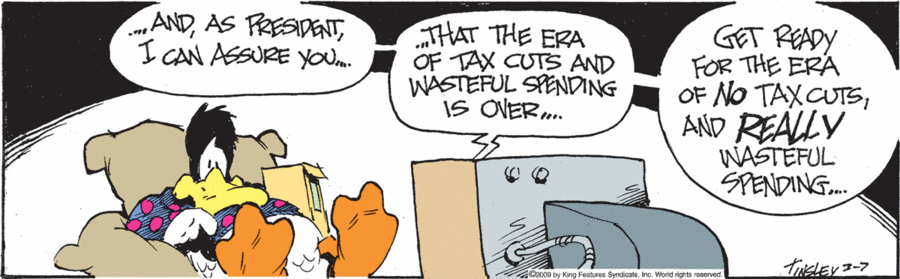
Taxing tax critics?

Posted by taxguru on March 11, 2009

Posted in comix, TaxHikes | Comments Off on Taxing tax critics?

Acceptable torture?

Posted by taxguru on March 10, 2009

Posted in comix, IRS | Comments Off on Acceptable torture?

Vehicles qualifying for maximum Section 179

Posted by taxguru on March 9, 2009

From a client with a 3/31/09 corp year-end:

Dear Kerry:

Our corp is considering purchasing a van such as a delivery van (GMC, Chevy, etc.). 

Could you please inform me of the IRS specifications that must be met to allow us to expense the entire amount.

Before we would purchase the vehicle I will check with you to make sure it meets the requirements.

Thanks.

My reply:

As you requested, here are the specifications for what a vehicle has to have in order to qualify for deducting all of its cost in the first year. Basically, these rules are most important if a vehicle either weighs less than 6,000 pounds or costs less than $25,000.

I excerpted this from my main tax reference source, TheTaxBook. Section 280F is the part of the tax code that severely limits the deprecation deduction for vehicles.

Vehicles not subject to Section 280F. The following vehicles are not subject to the depreciation limitations under Section 280F or any of the other listed property rules:
• Clearly marked police and fire vehicles.
• Unmarked vehicles used by law enforcement officers if the use is officially authorized.
• Ambulances used as such and hearses used as such.
• Any vehicle with a loaded gross vehicle weight of over 14,000 pounds that is designed to carry cargo.
• Bucket trucks (cherry pickers), cement mixers, dump trucks, garbage trucks, flatbed trucks, and refrigerated trucks.
• Combines, cranes and derricks, and forklifts.
• Qualified specialized utility repair trucks.
• Tractors and other special purpose farm vehicles.
• A vehicle used directly in the business of transporting persons or property for pay or hire, including school buses, and other buses with a capacity of at least 20 passengers.
• A truck or van that is a qualified nonpersonal-use vehicle.

Qualified nonpersonal-use vehicles.
These are vehicles that by their nature are not likely to be used more than a minimal amount for personal purposes. They include trucks and vans that have been specially modified so that they are not likely to be used more than a minimal amount for personal purposes, such as by installation of permanent shelving and painting the vehicle to display advertising or the company’s name. Delivery trucks with seating only for the driver, or only for the driver plus a folding jump seat, are qualified nonpersonal-use vehicles.

Trucks and vans.
Trucks and vans are passenger autos built on a truck chassis, including minivans and sport utility vehicles (SUVs) that are built on a truck chassis. They have the same definition as passenger autos, except that instead of unloaded gross vehicle weight, the definition is gross vehicle weight not more than 6,000 pounds. The Section 280F depreciation limits for trucks and vans are higher than the limit for cars.

Vehicles over 6,000 pounds.
Passenger autos rated at more than 6,000 pounds unloaded gross vehicle weight, or trucks and vans rated at more than 6,000 pounds loaded gross vehicle weight are not subject to the Section 280F depreciation limits. However, such vehicles may still be considered listed property for purposes of the other listed property rules, including the requirement that the vehicle be used more than 50% for business to take the Section 179 deduction.

Remember that the expensing deduction is only allowed if you actually place the vehicle into service before the end of your tax year. It won’t be sufficient to prepay for it by March 31 and then take delivery later in your next fiscal year. You need to actually use it before the end of the day on March 31 in order to claim it on this year’s tax return.

I hope this helps. Let me know if you have any specific questions.

Kerry

Follow-up:

Kerry:

Could you please let me me know if any or all of the following vehicles qualify for deducting all of the cost in the first year.

1)  2009 GMC Sierra 2500 crew cab pickup.  GVWR = 9600 lbs.  Bed length = 77 inches.  This is the same model we purchased nd were able to deduct in 2006.  Price = $39,480

2)  2009 GMC Savanna 12 passenger van.  GVWR = 9600 lbs.  The seats can be removed.  Price = $33,027

3)  The dealer also has the same model 2008 GMC Savanna available for about $21,000

Thanks.

My Reply:

I looked over the vehicle descriptions you faxed over and compared them to the rules for the first year expensing.

1.  Because the 2009 GMC Sierra has an exterior bed of larger than 72 inches, it would qualify for deducting the entire purchase price of $39,480 plus the sales tax.

2.  Because the 2009 GMC Savanna has seats for so many people, it would only qualify for a first year deduction of $25,000 of its purchase price.  The remaining cost would be depreciated over five years.

3.  Because the 2008 GMC Savanna costs less than the $25,000 limit, its entire $21,000 purchase price plus sales tax could be expensed in the first year.

Besides the fact that the vehicle needs to be actually placed into service before the end of 3/31/09, which I mentioned last time, another important point is that the dollar figure we are working with is after deducting any trade in value the dealer may give you if you are swapping another vehicle for the new one.  For example, with vehicle number 1 above, if you are receiving a trade in credit of $10,000, only the net cost of $29,480 will be available to deduct in the first year.

I hope this is clear and not too confusing.  Let me know if you have any more questions.

Kerry


TaxCoach Software: Finally! Plain-English Tax Planing That Builds Your Business!


Posted in 179, Vehicles | Comments Off on Vehicles qualifying for maximum Section 179

Selling Vacant Land

Posted by taxguru on March 9, 2009

Q:

Subject:  Vacant Land

If I sale my vacant land and meet all requirements can I still take an Exclusion on the land without the sale of my residence? Still confused about the tax law/ publication #523 any response would be greatly appreciated! Thanks

A:

You didn’t say if the vacant land was connected to your primary residence or not.

I have a section on this topic on my page on home sales.   

Unless you are planing to sell your home within two years of the separate sale of adjoining bare land, it will not qualify for any exclusion of gain.

You really need to be working with a professional tax advisor to see if there will even be any capital gains taxes on the land sale.  There is a special zero percent tax on some gains for some people in 2009 and 2010 that you might be able to utilize.

Good luck.

Kerry Kerstetter

Follow-Up:

KERRY, Yes the vacant land is connected to my primary residence. Thank you for the current reply.


Posted in 121 | Comments Off on Selling Vacant Land

Presidential Tax Returns

Posted by taxguru on March 9, 2009

I came across this page on the Tax Analysts site that has links to download pdf copies of several tax returns for a number of US Presidents (Obama, Bush 43, Clinton, Bush 41, Reagan, Carter, Nixon, & FDR), some Vice Presidents (Cheney & Biden), and some recent candidates (McCain & Palin).  From a true historical perspective, the 1913 tax return for FDR is interesting to look at because it was the very first year tax returns were required to be filed in this country.


Posted in Uncategorized | Comments Off on Presidential Tax Returns

Posted by taxguru on March 8, 2009


(Click on image for full size)

Posted in comix, Obambi, TaxHikes | Comments Off on

Posted by taxguru on March 8, 2009

Posted in comix, Dims, TaxHikes | Comments Off on

IRS ends use of private collectors

Posted by taxguru on March 8, 2009

From the AP:  IRS dumps private debt collectors, shifts pendulum

From IRS:  IRS Conducts Extensive Review, Decides Not to Renew Private Debt Collection Contracts

I didn’t have any real world experience dealing with the private collectors, so I can’t comment on how this experiment actually worked out.  If anyone wants to share some examples of their real life experiences with the contract collectors, I’d be glad to post those.  There’s a good chance this will be attempted again in the future.


Posted in Uncategorized | Comments Off on IRS ends use of private collectors

Leading by example…

Posted by taxguru on March 7, 2009

From Jay Leno via NewsMax:

Quite a scare in Washington, D.C. today. Police were called to the White House. Apparently President Obama was in a meeting with some potential Cabinet nominees when someone noticed a suspicious-looking document on the table that no one had ever seen before. Turns out it was just a tax form.

The president’s latest nominee for U.S. trade representative, Ron Kirk, who owes the government $10,000 in back taxes, has agreed to pay his taxes. When was there a choice? You try that on April 15.

Treasury Secretary Timothy Geithner announced he plans to go after tax evaders . . . this after failing to pay his own taxes. This is part of operation “Do As I Say, Not As I Do.”

 
From Jimmy Fallon via NewsMax:

Ten office workers won New Jersey’s $260 million Mega lottery. Unfortunately, under Barack Obama’s tax plan, they now owe $300 million.


Posted in Uncategorized | Comments Off on Leading by example…