Tax Guru – Ker$tetter Letter

Helping real people win the tax game.

  • Enter your email address to subscribe to this blog and receive notifications of new posts by email.

    Join 690 other subscribers
  • Blog Stats

    • 330,926 hits
  • Posts By Day

    February 2006
    M T W T F S S
     12345
    6789101112
    13141516171819
    20212223242526
    2728  
  • Subscribe

  • Special Pages

Archive for February, 2006

Quicken Tips

Posted by taxguru on February 12, 2006

Q-1:

Subject: Quicken Tips
 
Hi Kerry,
 
I came across your Quicken tips today and found it quite helpful.  I’ve been doing on-line banking for quite some time now and I’m a bit confused about managing multiple accounts.  We have several accounts at our bank (home chequing, home savings, child’s savings, 2 business acounts, a line of credit and a visa card) all with on-line banking.  It’s really handy being able to download all our transactions for each account into Quicken, but I’m running into problems when I try to use Categories/Transfer List since the transaction appears as a deposit in one account and a payment in the other account.
 
I figured out that using a Category doesn’t work since it looks like income when it really is just a transfer.  So I’ve tried using the Transfer List, but when I do this, it duplicates the entry in the other account.  I’m not sure the best way to handle this.  I’ve been using the Transfer List while in one account, then just deleting the one generated by the on-line banking in the other account, but I was wondering if you knew of a better way.  Any suggestions you have would be greatly appreciated.
 
Thanks,
 
PS  I hope this makes sense – I don’t have much of a background in this so I’m not too up on the lingo.  I’m also not sure if I’ve totally missed the boat on this.

A-1:

As I said in my online tips, transfers between bank accounts should not be posted to anything that will show up on the P&L, such as an Income or Expense category in Quicken. 

Ideally, only one entry needs to be made to reduce the balance in one account and increase the balance in the other.  If your online banking downloads the entries into each account’s register, you could very easily end up with duplicate entries for the transfers. 

You have a couple of ways to handle this.  You could just delete the duplicate entries.

Another way is to set up a new Bank Account in your chart of accounts called “Transfers.”  When posting transfers between actual bank accounts, have the offsetting side go to this new Transfers account.  You can train the online activity downloads from your bank accounts to use this account automatically.  If posted properly, the ending balance in the Transfers account should always be zero.

Good luck.  I hope this helps.

Kerry Kerstetter

Q-2:

Hi Again,
 
I liked your explanation of Cash Accounts.  I tried setting this up awhile back, but found I was very bad at keeping track of where the money was going.  My question is, what do you do in this situation to update your cash account to reflect the actual balance when you don’t know where some of it has gone.
 
Sorry if this is a totally silly question.
 
Thanks again,

A-2:

What I usually do is make a big adjusting entry as of the end of the year to bring the balance in line with reality, with the offset to something like Personal Supplies.  You should actually do this occasionally throughout the year, with the offsetting categories the closest to where you think the money was spent.  As long as you aren’t claiming a tax deduction for these expenditures, accuracy isn’t that crucial a matter.

I hope this helps.

Kerry Kerstetter

Follow-Up:

Thank-you so much!!


Posted in Uncategorized | Comments Off on Quicken Tips

SUV & Sec. 179

Posted by taxguru on February 12, 2006

Q:

Subject: section 179

Hi,

I’m thinking of purchasing a new vehicle in 2006 (no SUV)

I’m self employed realtor.

Is there still a bonus depreciation (exta$) deductible on 2006 returns?  I think you can write off a lot in the first 3 years but I’m not sure.

Thanks

A:

You really should be discussing this with your own personal tax advisor.  If you are trying to operate as a professional Realtor without a professional tax advisor, you are asking for big trouble.  Buying a new vehicle just for tax breaks would be a big mistake.  Don’t make matters worse by trying to do this on your own.

I assume that you are looking at buying a lighter weight vehicle. The maximum Section 179 for a vehicle under 6,000 pounds is much lower than for one over 6,000 pounds.

I have this all explained on my website.

but only a qualified tax pro will be able to give you more specific numbers for your situation.

Good luck.

Kerry Kerstetter


Posted in 179 | Comments Off on SUV & Sec. 179

Head of Household

Posted by taxguru on February 12, 2006

Q-1:

Subject: Tax question

Hi Kerry,

I am willing to pay for this advice, just please tell me how and how much.

My ex and I share custody of our 2 children exactly 50%.  Our divorce decree in 2004 states that we shall each claim one child as an exemption and shall each file as Head of Household. 

The IRS is disallowing my claim for HoH in 2003.  We were legally separated and meet all the other requirements. 

My question is:  if two parents have two children and each keep them exactly 50% of the time, can they each file as HoH?  How do you “prove” this to the IRS?

The IRS is asking for school records or medical records, which I don’t have.  Is there a precedent for this?

Thank you!

A-1:

What makes this a little more difficult than normal is the fact that you were still legally married as of 12/31/03.  Following are the rules for persons in your situation to qualify for HoH status, copied from page 4-7 of my QuickFinders book:

Considered unmarried. A married taxpayer can file as HOH if all of the following tests are met:
1) The taxpayer files a separate return.
2) The taxpayer paid more than half the cost of keeping up his or her home for the tax year.
3) A spouse did not live in the home during the last six months of the tax year. [Tax Court denied HOH status to a taxpayer whose spouse slept a single night in her home during the last six months of the year (Hopkins, TC Memo, 1992-326).]
4) The taxpayer’s home was the main home for more than half the year of his or her child or step-, adopted or foster child.
The child must be a dependent unless the child’s noncustodial parent is allowed the exemption under a decree, agreement or release of exemption. To qualify as a foster child, a child must be a member of the taxpayer™s household for the entire year.
5) The taxpayer is a U.S. citizen or resident during the entire year.

Keeping up a home. The cost of upkeep includes property tax, mortgage interest, rent, utilities, repairs, property insurance, food consumed on the premises and other household expenses.

Two unmarried taxpayers living with their own dependent children in a shared home may both qualify as HOH if they maintained separate households and each paid more than half the cost of his or her separate household (SCA 1998-041). Factors discussed in the memorandum that showed separate households include: the adults did not share a bedroom, each household had a separate phone, and the taxpayers gave gifts separately and made separate charitable contributions.

If you note, the rules specify “more than half the year.”  This means that claiming exactly 50% custody for each of you makes you both ineligible.  You may want to negotiate with your ex and decide which one of you would most benefit from claiming more than 50% custody for 2003 for at least one of the kids so that either you or she can benefit from the HoH filing status.  Changing the custody to something like 49/51 and 51/49 might allow you both to qualify for HoH.

Unfortunately, this is a very commonly misinterpreted technicality in the tax code, where the dividing point is designated as more than 50% and not exactly half. 

This is also not going to just be a problem for 2003.  Even when you are single, the language to qualify as Head of Household specifies more than 50%.  Whoever advised you that you could both claim the HoH with an exact 50/50 division of custody was not reading the tax rules properly.   You may want to revisit the entire agreement for your custody situation to see if you can work out a better plan than the screwed-up one you currently have.  

Having two kids should make the solution a lot easier than if there were only one.  While your own legal and tax advisor may come up with a better solution, I have often seen cases like this where each parent gets to claim that one of the kids was with him/her for more than half of the year.  That would make both parents eligible for the HoH.

I hope this helps.  As always, you should consult with a tax pro for more specific advice on how these and other tax rules affect your situation.

Good luck.

Kerry Kerstetter

 Q-2:

Thanks, Kerry.

I guess the real glitch is how you prove the >50%.  Using your recommendation of each kid being 51/49 and 49/51,

It could be a challenge because it looks like the only acceptable methods regarding the kids are:

 DOCUMENTS TO SUPPORT Head of household status

 1.   School records listing the qualifying person’s address as the same

 2.   Medical records listing the qualifying person’s address

 The kids’ records would need to be different.

A-2:

I don’t see how the school record addresses are as important as you and your ex coming up with a consistent record of the number of days each child lived in each home.  If you can coordinate the preparation of a kind of attendance record for each kid that you will both vouch for, and if that shows you each with one of the kids more than 182.5 days in your home during the year, you should be okay in terms of qualifying for the HoH status.

I’m assuming that you and your ex each pay the cost of maintaining your own separate homes, so there will be no problems covering that part of the HoH requirement.

Good luck.

Kerry Kerstetter


Posted in Uncategorized | Comments Off on Head of Household

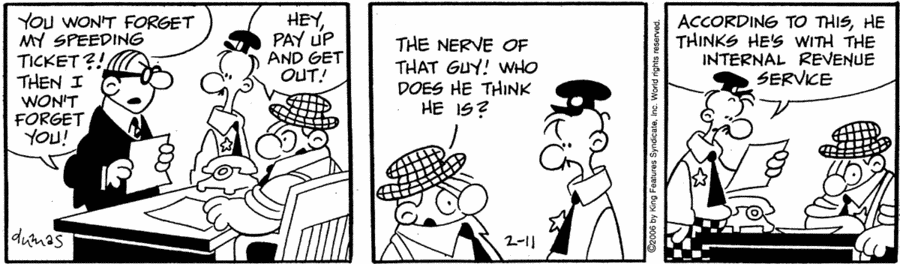
Paybacks can be a…

Posted by taxguru on February 11, 2006

(Click on image for full size)


Posted in Uncategorized | Comments Off on Paybacks can be a…

For those who believe everyone is a tax cheat:

Posted by taxguru on February 11, 2006


Think Twice Before Taking that ‘Standard Deduction’ – According to Gail Buckner, a GAO study showed that 2.2 million tax returns intentionally overpaid because the filers were too lazy to itemize their deductions rather than claim the standard deduction.


Posted in Uncategorized | Comments Off on For those who believe everyone is a tax cheat:

It usually evens out in the end.

Posted by taxguru on February 11, 2006

(Click on image for full size)

Posted in Uncategorized | Comments Off on It usually evens out in the end.

Gift Limits

Posted by taxguru on February 11, 2006

Q:

Subject: Gift Question
 
Hi,
I found your website while looking for an answer…. I understand the single gift limit of $11k per person. However. Is there a annual limit of gifts. In other words… How many $11k (or $12k etc. depending on the year) gifts can I give? As long as each gift is to a different person is there a limited number?
 
Thanks

A:

You really should be working with your own personal professional tax advisor on matters such as this because you are misunderstanding the rules.

As you can see on my website, the annual allowance of $12,000 (as of 1/1/06) is not per gift.  It is total per recipient per calendar year.

There is no maximum number of people to whom you can make gifts.  The gifts do have to be bona fide to the original recipients without conditions.  For example, you can’t give 100 people each $12,000 with the requirement that they pass that money on to another person in order to avoid the per person limit.

Gifts totaling more than the annual allowance won’t automatically cost you any actual gift tax.  You will have to report them to IRS on a Gift Tax Return (Form 709), but they can be offset against your one million dollar lifetime exclusion.

Again, any competent professional tax advisor should be able to help you set up an appropriate gifting strategy for your particular circumstances.

Good luck.

Kerry Kerstetter


Posted in Uncategorized | Comments Off on Gift Limits

QuickBooks vs Quicken

Posted by taxguru on February 11, 2006

Q:

Subject: Quickbooks -vs- Quicken H&B -vs- Peachtree

Sir,

I notice that your comparison was published 2003.

What is your opinion and comparison of the subject programs.

The user is a non-accountant type, non-for-profit form Quicken H&B bookkeeper.

What’s best?

Thank You.

A:

As I’ve said in numerous blog posts, each year’s versions of the Quicken and QB programs makes them more and more dissimilar.  Each year, I have a lower opinion of Quicken and a higher opinion of QB for proper handling of double entry accounting.

A non-profit organization should definitely be using QB and not Quicken.

Kerry Kerstetter


Posted in Uncategorized | Comments Off on QuickBooks vs Quicken

Annuities & Trusts

Posted by taxguru on February 11, 2006

Q:

Subject: Annuities in a irrevocable trust – Tax Deferred?

 Hello Kerry,

I am considering purchasing an annuity for my brothers trust.  This trust is an irrevocable special needs trust where my brother is the beneficiary.  The trust was designed to preserve the bequest from my dad, target it for growth should the money be needed to take care of John, and to be careful not to disqualify John from and State or Government benefits.     

I have posed the question that since the trust is a non-natural personal will the tax deferral benefit of an annuity be void and will the trust be taxed on growth each year.

The investment representative says no it will not be taxed, the growth will be deferred.  However, the CPA who has been managing the returns says the gains will lose their tax deferred status.

Can you shed any light on this matter?

Thanks for you insight.

A:

Unfortunately, there is no easy answer here.  I browsed through the annuity and trust sections of my reference books and things are different depending on what kind of annuities are involved, the details of the trust, along with the actual ownership and beneficiaries of the annuities.  Each combination of those factors changes the net tax effect.

It would be best to have both your annuity salesperson and CPA lay out their evidence for their conclusions in terms to the factors I mentioned.  I obviously don’t know either of those persons, and this may seem a bit biased; but in similar cases like this, I have found the CPA’s objective analysis of the facts to be more trustworthy than the opinion of a person who is looking at earning some very substantial commissions from the sale of annuities.  Too often, I have seen cases where annuity salespeople say anything the clients want to hear just to close a sale, without doing any actual research as to its accuracy. 

Good luck with that.

Kerry


Posted in Uncategorized | Comments Off on Annuities & Trusts

Corporate Withdrawals

Posted by taxguru on February 11, 2006

Q:

Subject: just wandering

Can cash withdrawals from the corporations business account be considered a payroll expense if it’s withdrawn from an ATM machine at a casino?

Seriously,

A:

As you know, every bit of activity in the corp bank account has to be accounted for on the corp’s books and reported on the 1120.

If an employee receives his payroll via ATM withdrawals, you could post it that way on the books.  Of course, if it’s a W-2 employee, you will need to gross up the actual cash taken out to arrive at the gross pay and applicable tax withholdings, which you will also have to report on the 941.

There are obviously many other ways to treat ATM withdrawals, such as loans from the corp, or even as straight 1099 pay.  You obviously need to work with the persons concerned to make sure everyone is in agreement with how the withdrawals are being posted on the corp books.

Good luck.

Kerry Kerstetter


Posted in Uncategorized | Comments Off on Corporate Withdrawals