


Posted by taxguru on February 16, 2008
Posted in comix | Comments Off on Tax change, Huckabee style?
Posted by taxguru on February 15, 2008
Q:
Subject: Exchange Question
Will I invalidate the 1031 exchange if I don’t use all the money held in escrow to buy replacement property?
A:
Not reinvesting the full amount of your disposal leg proceeds won’t invalidate the 1031 exchange if everything else has been done properly.
However, it will, in most cases, not allow you to roll all of the gain from the original property into your replacement property. The actual calculation for the Form 8824 worksheet is a little messy; but the quick and dirty way to look at is that the unreinvested funds will be taxable in the year that you receive them. For example, if your disposal leg happened in 2007 and the 180 day reinvestment period expires in 2008, and you are sent the remainder of the funds in 2008, the taxable portion of the gain will be shown on your 2007 tax return as a deferred installment sale, with the actual gain subject to tax on your 2008 tax return. If both ends of the exchange happened inside the same tax year, the unreinvested potion will be subject to tax on that year’s tax return.
The tax rate that the unreinvested funds will be hit with will be the highest rate applicable to the property’s disposal. This normally works out to be the 25% Federal depreciation recapture rate, plus the comparable state rate, if you or the property are located in a taxable state.
I hope you’re picking up on the fact that the actual tax calculations are very tricky and are not something you should even think about attempting on your own. The services of an experienced professional tax preparer will more than pay for themselves in a case like this.
Good luck. I hope this helps.
Kerry Kerstetter


Posted in 1031 | Comments Off on Unreinvested Exchange Proceeds
Posted by taxguru on February 15, 2008
Q:
Subject: Question about security deposit and 1099
We (the tenant) just received a 1099 for a refund of our security deposit (office space that we rented) from a previous landlord. It is my understanding that security deposit is not income to the landlord when received nor to the tenant when returned to the tenant. It would only convert to income if it is forfeited and that would be income for the landlord not the tenant. Can you point me to some printed verification of my thought or tell me I am incorrect?
Thanks for your time
A:
How landlords treat the handling of security deposits is optional.
One way (and the technically correct way) is to book it when received into a liability account and not as income. If it is later forfeited by the tenant, it is transferred from the liability account into the Rent Income account. If it is repaid to the tenant, the check is posted to the same liability account as the deposit was and would thus not be a deduction from current year income.
Since that is a little too complicated for many people to keep track of, what is more commonly done in real life is for the landlords to use a more pure cash basis of reporting rental income and expenses. Under this method, all monies received, including potentially refundable security deposits, are reported as rent income in the year received. Any security deposits refunded to tenants are then deducted as expenses in the year paid out.
As long as the security deposits are handled consistently under whichever method the landlord chooses, things will be fine.
This only applies to money specifically designated as security deposit and does not apply to any money paid by the tenant which is specified as Last Month’s Rent. That is taxable income to the landlord in the year it is received, even though the last month could be several years away.
Here is an excerpt from Page 7-5 of the latest edition of The TaxBook, a reference source any good tax pro should have:
“Security deposits. A security deposit is not included in rental income when received if the property owner plans to return it to the tenant at the end of the lease. If any amount is kept during the year because the tenant did not live up to the terms of the lease, include that amount as rental income. If an amount called a security deposit is to be used as a final payment of rent, it is advance rent and is included as income in the year received.”
It seems like your landlord is probably using the second method of accounting for security deposits on his tax returns and is planning to claim the refund as an expense on his current tax return.
As your own personal professional tax advisor will most likely confirm, your treatment of the refunded security deposit on your tax return will need to be consistent with how you accounted for the original payment of that deposit. If you followed proper accounting methodology and booked it into an asset account on your books, the refund will be posted to that same asset account and will not be income to you.
If, on the other hand, you deducted that payment as a rent expense, you will need to pick up the refund as either income or a reduction of the current year’s rent expense. The latter would be the proper way to handle a refund of a previously deducted expenditure.
I hope this helps. Your own professional tax advisor can give you more specific advice on this matter.
Good luck.
Kerry Kerstetter


Posted in Uncategorized | Comments Off on Refunded Security Deposit
Posted by taxguru on February 15, 2008
Q:
Subject: Amortizing the cost of acquiring a mortgage
Hello Kerry:
Thank you for providing such wonderful information.
My question is rather simple. I acquired rental property in 2007 and want to amortize the loan costs. I understand how to calculate the amortization and that it is reported on line 18 (“Other”) of schedule E. However, since I acquired the property (and mortgage)in 2007 I need to file Form 4562. The amortization is done in Part VI of the form and everything is fairly straightforward except for 2 things.
1) What do I list in column (d) – “Code section”?I’ve searched the IRS site and the intranet high and low but can’t seem to find any information on this. Form 4562 instructions list some codes, am I to use one of them? The only one that seems to make sense is Section 197 – Certain intangibles.
2) If I put “Property A loan origination costs” as a description, can I use a 5 yr amortization like you suggest? If I use code 197, am I stuck with a 15 yr term?
Thank you.
A:
When I enter a new loan costs item into the Lacerte depreciation schedule, I always choose Code Section 461 – Points as the appropriate amortization code section and manually enter the number of years that is appropriate for that particular item. I’ve been doing that for over 20 years in Lacerte and IRS has never once had any problems with it; so that should work for you.
Kerry Kerstetter


Posted in Uncategorized | Comments Off on Amortizing Loan Costs
Posted by taxguru on February 15, 2008
Q:
Subject: section 179 limits
Hi Tax Guru:
I have just finished reading the 179 entry on your website. Quick question, as a small business owner, can I purchase a new 6000 lb suv every year to qualify for the $25K deduction?
A:
Of course you can, if you want that many SUVs. I used to have a client who traded in his car every six months for a brand new one.
As I’ve discussed numerous times, there are tax consequences to the way in which the old SUV is disposed of; selling vs. trading.
Your personal professional tax advisor can give you more specific info for your unique situation.
Good luck.
Kerry Kerstetter


Posted in 179 | Comments Off on Multiple Vehicles For Sec. 179
Posted by taxguru on February 15, 2008
Q:
Subject: Confusion…
Kerry – Thanks for having your webpage! I found it very interesting reading. Unfortunately, I’m still wondering if I’m doing things correctly.
Suspect some background would be good:
I’m divorced, and paying child support (for another 5-6 years), and alimony. My wife had legal access to my 1040’s until now (that has ended in 2008 without a court order).
I’ve remarried to a legal resident, but non-US citizen (think thats relevant to S-Corp designation?). We formed a C-Corp in late 2006 to deal with single family home rentals we were interested in doing. Since then, we have grown to 6 homes in the area. Someday we would like to own 10, but no more. All are mortgaged in my name, since personal mortgage rates are WAY lower than Corporate mortgages. The C-Corp is the public interface that manages the property, accepts rental payments, pays the mortgages, reimburses travel expenses, etc.
At 10 homes, this company MAY generate $5000/month in profits in perhaps 10 years – and will be losing money or barely breaking even for some time. It was our plan to simply pay my wife a salary to drain that income from the company.
I am wondering if I should convert this C-Corp into an S-Corp, or LLC, in order to simplify accounting. e.g. Turbo-Tax handles rental properties well… and Intuits Rental Property Manager can feed Turbo-Tax directly. This would reduce (eliminate) my dependence on a local CPA that if a MAJOR expense ($150/hr and he loves to try and verify every transaction that occurs in the year, running up the total bill).
Any suggestions?
A:
There are far too many options to consider and possible scenarios that can be used to achieve your goals for me to even begin giving you specific advice via this medium. You will need to work directly with an experienced tax pro who can analyze your unique circumstances.
I wish I could be more help; but I already have too many clients to take care of properly; so we are still trimming back on the difficult clients and are not accepting any new ones at this time.
Unfortunately, we don’t have anyone specific to whom we could refer you. I did recently post some names and links for some like-minded tax pros around the country.
If you haven’t already done so, you should check out my tips on how to select the right tax preparer for you. You should note that geographic location should not be the main criterion for selecting a tax pro.I do want to caution you from making these kinds of decisions based on your tax and accounting fees. That is a very short-sighted approach to this kind of thing. For example, I have plenty of clients with corporations whose annual charges are at least a thousand dollars more each year than they would be if we only had to prepare an annual 1040. However, I know for a fact that in almost every one of those cases, the proper use of their corporations allows them to reduce their overall tax bill by anywhere from $10,000 to as much as $50,000 each year.
I have long advised that there are what I call nuisance factors in having to keep separate books and file separate tax returns for corporations. Only you can decide how much those factors are worth in dollars and cents. However, for most people, spending a little extra time and $1,000 more in professional fees in order to save well more than $10,000 in taxes each year makes the nuisance factor seem quite affordable.
As I’ve constantly warned, there is no one size fits all in terms of the proper entities to use. C corps do have a lot of tax savings opportunities if you work with an experienced tax professional. Either way, if you were to use an S corp or an LLC, you would still need to keep separate books and file special income tax returns for them; so I don’t see how that should be much of a factor in your decision process.
Also, as I’ve warned for decades, if you think any tax software, whether it’s the consumer oriented TurboTax or the extremely expensive professional Lacerte software that I use, can take the place of a good tax pro, you are dangerously mistaken. Nowhere is the adage of garbage in, garbage out more appropriate than with tax software. Saving a few hundred dollars by trying to prepare your own tax returns is insane. Any good tax person will save you much more in taxes than his/her fee, as well as give you more protection against screwing things up on your own.
I’m sorry to be so blunt; but these points needed to be made.
I wish I could be of more assistance; and I wish you the best of luck.
Kerry Kerstetter
Follow-Up:
Appreciated Kerry - I'll go surf your section on selecting a tax preparer.

Thanks,

Posted in corp | Comments Off on Reasons for C or S Corp
Posted by taxguru on February 14, 2008
The folks at the increasingly useful TaxCoach software have just produced the following handy and concise summary of the new tax law that can be automatically personalized for clients set up on their system.
Economic Stimulus Package Offers Business Tax Cuts
President Bush has just signed a $168 billion stimulus package to prop up the economy and help prevent a recession. News reports have focused on tax rebates for individuals. But you may not realize that the package includes generous incentives for buying business equipment as well.
Want more cash in your pocket? The new law reduces the 10% federal tax bracket to zero for 2008 — then delivers the savings now in the form of rebates ranging up to $600 for unmarried individuals, $1,200 for married couples, and $300 per child up to a maximum of $600. This break phases out for incomes above $75,000 ($150,000 for joint filers).
The new law also gives you a 50% bonus depreciation deduction for new equipment you buy for your business in 2008. It raises the Section 179 first-year expensing limit from $128,000 to $250,000. And it doubles the phaseout for Section 179 deductions from $400,000 to $800,000. This is great news if you’re planning to buy vehicles or equipment for your business, or even to renovate business premises.
This is a special, limited-time break, so before you buy new equipment, be sure to call us.


Posted in NewTaxLaws | Comments Off on Quick Summary of New Tax Law
Posted by taxguru on February 14, 2008
Q:
Subject: Section 179
My wife is currently are using the standard mileage deduction on a Chevy we transferred into business service 4 years ago. We are expecting a large tax liability this year and next year my wife is taking off 3 months from her LCC business (she uses schedule C for business income) so we want to take the section 179 depr deduction this year.
If we buy the car on 12-31-07 and put it into service that day, it will be used 100% this year for the business. The existing vehicle (which will be traded in with a $10,000 trade value) will have about 75% business. Can I still claim 100% of the 179 deduction on the new SUV?
If next year the business use drops to 75% is there any recapture requirements or does that only effect next years actual cost deduction?
Finally, any problem with using both the standard deduction on the old vehicle for 2007 (it will be taken out of service on 12-28-07) as well as using the 179 deduction for the new car? The cost of the new car is $45k, with the trade in my cash loan is $35k so I have $10k for deprecation, would I use the 30% or 50% method going forward in future years for the $10k left to deduct using the actual method?
Is the trade still considered like kind even though I changed deprecation methods?
I know this is late in the season, but we are making the purchase, now we have to decide how to handle the tax issues.
Thanks
A:
You really need to be working with a professional tax advisor on matters such as this rater than trying to stumble your way through the tax maze on your own.
Just some quick answers to your main queries.
There is no actual Section 179 or deprecation recapture required in subsequent years unless the business usage percentage drops below 50% or the asset is sold. If you claim 100% business usage for 2007 and then the business usage drips to 75% in 2008, the 2008 depreciation deduction will most likely be zero, depending on how much of the purchase price you are expensing for 2007.
The numbers you gave are a little confusing. Basically, the amount eligible for Section 179 expensing is the excess of the new vehicle’s purchase price over the trade in allowance you are given. For example, if the new vehicle is costing $45,000 and the dealer allows you a net of $10,000, the extra $35,000 is available for the Section 179, subject to the various other limits. If there is a pay-off or assumption of an old loan on the old vehicle, the calculation changes, with a lower amount being available for Section 179.
Any undepreciated cost of the older vehicle would continue to be depreciated over the life of the new vehicle. Since you have been using the standard mileage method, you will definitely need to have a professional tax advisor do the basis calculations on the old vehicle, the like kind exchange worksheet and form (8824) and the new basis of the replacement vehicle. Like kind has to do with the vehicle for vehicle and the fact that you are going to be using different deprecation methods for the new vs old one doesn’t have any bearing whatsoever.
Again, you should be able to see that this can get very messy on your 1040 and you definitely need to be working with a tax pro who can see that everything is reported properly.Good luck.
Kerry Kerstetter


Posted in 179 | Comments Off on Sec. 179 For Vehicles
Posted by taxguru on February 14, 2008
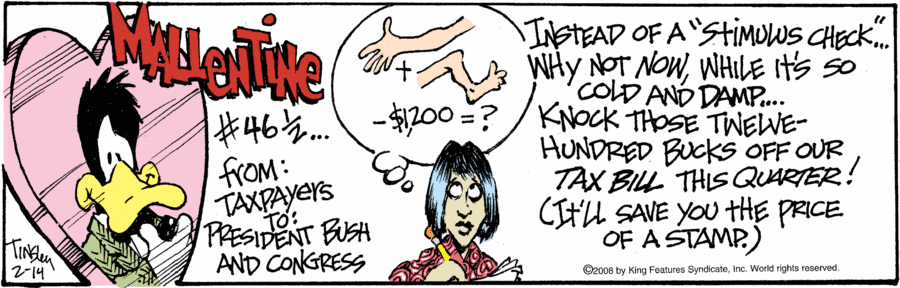
(Click on image for full size)

Posted in comix, Rebates | Comments Off on A better rebate plan?
Posted by taxguru on February 13, 2008


Posted in comix, TaxCuts, TaxHikes | Comments Off on Breaking even?


 Tax Guru - Ker$tetter Letter