Tax Guru – Ker$tetter Letter

Helping real people win the tax game.

  • Enter your email address to subscribe to this blog and receive notifications of new posts by email.

    Join 690 other subscribers
  • Blog Stats

    • 342,788 hits
  • Posts By Day

    May 2026
    M T W T F S S
     123
    45678910
    11121314151617
    18192021222324
    25262728293031
  • Subscribe

  • Special Pages

IRS to Tighten Enforcement of Like-Kind Exchange Rules

Posted by taxguru on February 13, 2008

Courtesy of the most recent email bulletin from ACAT.

If you are considering a like-kind exchange (also known as a Section 1031 or Starker exchange), you need to review the IRS regulations that apply…and do it right.


Like-kind exchanges allow investors to defer taxes when they dispose of property they currently own and replace it with similar property.  However, the Internal Revenue Service plans to increase audits and enforcement of these exchanges beginning mid-2008.


Usually when a business or investment property is sold, the seller must pay tax on any profit.  The tax varies depending on the type of income and the current tax rate.  For example, if you purchased land for $100,000 and sold it for $200,000, you could expect to owe $15,000 federal income tax on the transaction, assuming a current capital gains tax rate of 15%.


With a like-kind exchange, it is possible to purchase property for $100,000, sell it for $200,000, buy another like-kind property for at least $200,000, and avoid income taxes on that sale.  But you have to follow the IRS rules precisely, and this requires planning prior to the transaction.


First, the property sold and the replacement property must be “like-kind.”  IRS rules and regulations offer guidance to help determine what qualifies as like-kind property.  For example, you can exchange a single-family home for an office building, or an apartment complex for a shopping center. But you can’t exchange your home for an oil well and you can’t exchange real property for a business. 


Second, many like-kind exchanges will require the assistance of a qualified intermediary in order to comply with all of the requirements for a tax-free exchange.  You can usually find a qualified intermediary in your area by checking the Yellow Page listings under “Title Companies.”


All like-kind exchanges must be reported to IRS by filing Form 8824 with your federal income tax return.


Sounds confusing?  Studies by the IRS and the Government Accounting Office have found consumers don’t understand the rules.  But help is on the way.


The IRS has updated Publication 17 “Your Federal Income Tax” to better tell taxpayers about like-kind exchanges.  Additional information about the like-kind exchange process is found in IRS Publication 544 “Sales and Other Dispositions of Assets,” and in the instructions for Form 8824.


There are significant savings you can realize. But the best advice is to get your accountant involved at every step.


This information is provided as a public service, and should not be construed as individual accounting or tax planning advice.  For information on how these general principles apply to your situation, please consult an accounting or tax professional.


Posted in 1031 | Comments Off on IRS to Tighten Enforcement of Like-Kind Exchange Rules

eBay Auctions and Garage Sales

Posted by taxguru on February 13, 2008

Courtesy of the most recent email bulletin from ACAT.

Did you hold a garage sale this year to get rid of excess “stuff”?  Or maybe you auctioned items on eBay…or started a home-based business of on-line auction sales?  The IRS has rules and guidelines to follow in reporting your income from these sales.


Did you sell a few personal items on eBay?

If you auctioned a few personal items on eBay and the sale price was less than what you paid for the item (or its depreciated value), you generally do not have to report this income on your tax return.


Did You Have an Online Garage Sale?
If your online auction sales (eBay or some other online service) are the Internet equivalent of an occasional garage or yard sale, you generally do not have to report the sales. In a garage sale, you generally sell household items you purchased over the years and used personally. If you sell the items for less than you paid for them, the sales don’t have to be reported on your tax return. Losses on personal use property are not deductible, either. However, see below for gain reporting.


Did You Sell Appreciated Assets at an Online Auction?
An “appreciated asset” is something that has increased in value with the passing of time.  Examples of appreciated assets often include art, antiques and collectibles. If you have online auction sales of property where the sales price is more than your cost, you usually will have a reportable gain. These gains may be business income or capital gains.


Did You Start a Home-Based Online Auction Seller Business?
If your online garage sale turned into a business and/or you have recurring sales and are purchasing or producing items for resale with the intention of making a profit; you may have started an online auction business.  The sales of these items must be reported on your income tax return.


Are Your Online Auction Sales a Business or a Hobby?
If you regularly purchase or produce items to sell online, you must report the income on your income tax return.  How you report that income depends on whether your online auction sales are considered a “business” or a “hobby.”  The factors to consider in making this determination are discussed at length in IRS publication 535.  In summary, the activity is a hobby if it is done primarily as a recreational activity without a distinct profit motive.  The activity is probably a business if it is carried on in a businesslike manner with a clear profit motive. 


If your online sales constitute a business, the income is reported on Schedule C, Profit or Loss from a Business.  Allowable business expenses are also listed and deducted on the Schedule C, so that only the net profit or loss is included in your adjusted gross income.    


If your online sales are a hobby, your expenses can not exceed the income from the activity, i.e. you may not show a loss.  You may not deduct any expenses at all unless you itemize your deductions on schedule A of your tax return.  In addition, your expenses may be reduced by a percentage of your income. 


Did You Sell Depreciated Business Assets?
If you sell business assets or close your business, you may have capital gains, ordinary gains and depreciation recapture to report. An example is the sale of an automobile used for business.


If you have questions, see your tax professional for details and instructions on your specific situation.


This information is provided as a public service, and should not be construed as individual accounting or tax planning advice.  For information on how these general principles apply to your situation, please consult an accounting or tax professional.


Posted in Uncategorized | Comments Off on eBay Auctions and Garage Sales

Charitable Gifts – Still Deductible, But You Must Have Proof

Posted by taxguru on February 13, 2008

Courtesy of the most recent email bulletin from ACAT.

If you are like most Americans, you make donations throughout the year.  Your schools, religious groups, museums, Salvation Army, Cancer Fund and many more non-profit organizations benefit from your giving.


The U.S. Congress recognizes the benefits of your generosity and has steadfastly maintained deductions on your federal income tax for charitable giving.  But this doesn’t mean that there aren’t regulations to be followed.  And the rules have gotten stricter for reporting charitable gifts on your 2007 tax return.


Donations of Cash

The good news: You are still permitted to take substantial tax write-offs for charitable contributions – as high as 50 percent of your adjusted gross income.


The old news: Charitable contributions of $250 or more require a specific written acknowledgment from the charity. 


The new (stricter) news: Any out-of-pocket cash donations you make without documentation cannot be deducted. No longer can you deduct cash dropped in the collection plate at church or synagogue.


The solution: Get a receipt for all donations.


All donations must be documented by a bank record (cancelled check or bank statement) or a written communication from the charity.  The documentation must include the name of the charity, the date of the contribution, and the amount of the contribution.


For contributions of $250 or more, you can deduct the contribution only if you have an acknowledgment of your contribution from the charity.  A bank record is not sufficient documentation for a donation of $250 or more.


Donations of Clothing and Household Goods

The good news: These donations are still deductible.


The hard to understand rules:  Experts are still working on how to interpret the language which reads, “to be deductible, clothing and household items donated to charity after August 17, 2006, must be in good, used condition or better.”  How does a taxpayer document the condition of used items?    One option: Consider taking photos.


The documentation required for deduction of a non-cash donation varies with the amount of the deduction.  If the deduction is less than $250, only a receipt from the charitable organization is required.  For a deduction of $250 or more, a written acknowledgment from the charity is needed.  If the deduction exceeds $500, detailed information on the items donated must be reported on your tax return.  For donations exceeding $5,000 in value, a qualified appraisal is required to support the valuation.  Recommendation:  For all non-cash contributions, keep an itemized detailed inventory of what you donate including cost, date bought, condition and current value.  Consider an appraisal or other means of documenting the value of expensive items that you plan to donate to charity.


In all cases: Consult your tax advisor for help with your specific situation.


This information is provided as a public service, and should not be construed as individual accounting or tax planning advice.  For information on how these general principles apply to your situation, please consult an accounting or tax professional.


<script language="'JAVASCRIPT1.1'"
src=”http://affiliate.softcom.biz/aw.aspx?A=172&G=16&Task=Get&Browser=N”&gt;


Posted in Charity | Comments Off on Charitable Gifts – Still Deductible, But You Must Have Proof

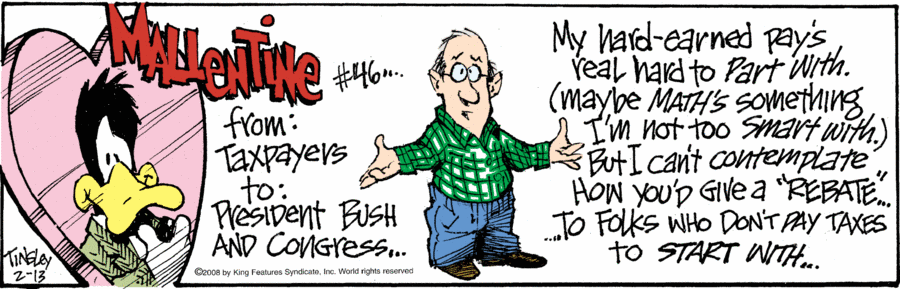
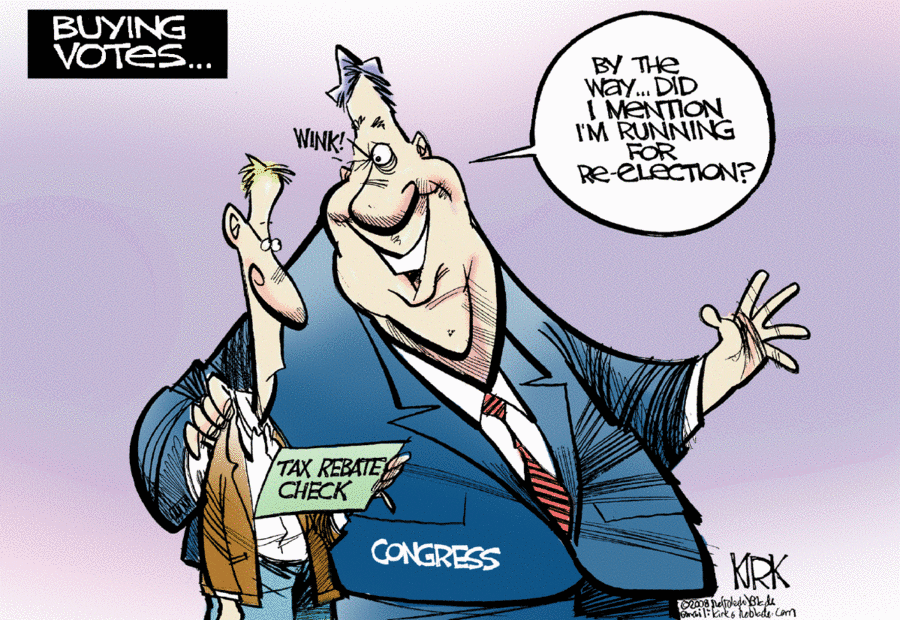
Understanding the purpose for the rebates?

Posted by taxguru on February 13, 2008


(Click on image for full size)


(Click on image for full size)

Posted in comix, Rebates | Comments Off on Understanding the purpose for the rebates?

Economic Stimulus Act of 2008

Posted by taxguru on February 11, 2008

The folks at The TaxBook have released a very handy six page pdf explanation of the new bill that everyone should download and keep handy to explain to clients.  It includes much more detail on the increased Section 179 and special 50% depreciation allowance than you will find anywhere in the drive-by media, which have been only covering the ridiculous rebate portion of the law.


Posted in TaxCuts | Comments Off on Economic Stimulus Act of 2008

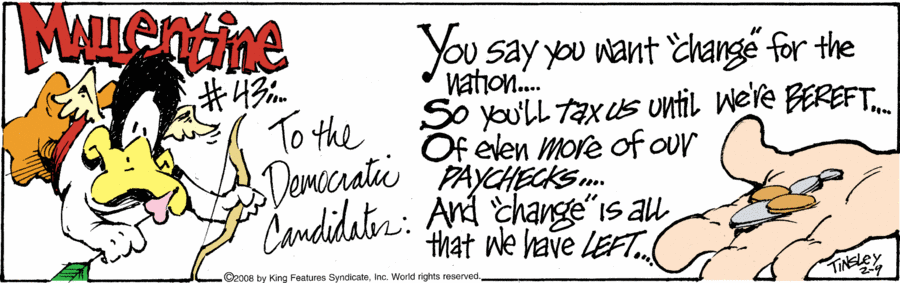
Tax change?

Posted by taxguru on February 10, 2008

(Click on image for full size)

Posted in comix, TaxHikes | Comments Off on Tax change?

Smelly tax payment leads to arrest

Posted by taxguru on February 9, 2008

This guy in Oregon learned a very expensive lesson about how not to pay his taxes.

The investigation started when a Benton County tax clerk noticed that the $600 in cash that Michaelis used to pay his taxes smelled like marijuana.

He should have used a different kind of money launderer first.

 Thanks to Neal Boortz for this story.


Posted in Money | Comments Off on Smelly tax payment leads to arrest

Reporting Gifts

Posted by taxguru on February 9, 2008

Q:

Subject: Cash Gifts

My 90 year old grandfather has been giving my brother and I $11,000 each for the past 2 years. I do his taxes but have not been showing these payments on his tax return as he does not itemize. How do I show these as cash gifts? Do I have to itemize to do this?


Thanks for any advice or tips you may have.


A:

Gifts are not shown anywhere on income tax returns, either for the giver or the recipient.  They are not deductible by the giver, nor are they taxable income to the recipients.

The Gift Tax system is actually separate from the income tax system.  If your grandfather were to give any single person more than $12,000 during a calendar year, he would have to file a Gift Tax return (Form 709).  There are exceptions for certain other kinds of expenses, such as medical and education costs.

If he starts giving away more than the annual $12,000 tax free limit, he should be working with a qualified professional tax advisor.

You can see more about the Gift Tax on my website

Good luck.

Kerry Kerstetter


Posted in Gifting | Comments Off on Reporting Gifts

Extreme withholding at the source…

Posted by taxguru on February 8, 2008

Posted in comix | Comments Off on Extreme withholding at the source…

Our meters are spinning…

Posted by taxguru on February 8, 2008

Posted in comix, cpa | Comments Off on Our meters are spinning…