Tax Guru – Ker$tetter Letter

Helping real people win the tax game.

  • Enter your email address to subscribe to this blog and receive notifications of new posts by email.

    Join 690 other subscribers
  • Blog Stats

    • 343,790 hits
  • Posts By Day

    May 2026
    M T W T F S S
     123
    45678910
    11121314151617
    18192021222324
    25262728293031
  • Subscribe

  • Special Pages

Has IRS expanded definition of reponsible parties for payroll taxes?

Posted by taxguru on November 21, 2007

Q:

Subject: Tax question


Mr Guru – I’ve heard from 2 other CPA’s plus my Paychex Representative that, after Jan 1, IRS is going to hold payroll preparers, be they CPAs or whoever, responsible for unpaid 941 taxes.  Have you heard anything along these lines?  How can IRS do that in the first place?  Let me know what you know.  


Thanks,

A:

I haven’t heard about that payroll tax change and can’t find any mention of it on the IRS website.  You should ask those other folks for some documentation of this change.

Kerry


Posted in Uncategorized | Comments Off on Has IRS expanded definition of reponsible parties for payroll taxes?

Posted by taxguru on November 21, 2007

Posted in comix, IRS | Comments Off on

Beware taking tax advice from insurance salesmen…

Posted by taxguru on November 20, 2007

In response to a phone call from a long term client, whose wife’s uncle was being pressured to cash in stocks and replace with annuities, I sent the following:

In regard to your phone call about your wife’s uncle, there are a number of things to consider.  While there are tax free trades possible for some kinds of annuities and insurance policies, he should have a financial pro see if his situation will qualify.

I can’t handle this; so he will need to work with a competent financial advisor.  Some thoughts that did come to mind:

It’s a very serious red flag when a financial advisor puts a rush priority on doing something and doesn’t allow you adequate time to conduct due diligence

There are tons of scammers selling inappropriate annuities to older folks. Google this and you will get a ton of hits.  Annuities generally have huge commissions for the agents; so there is a conflict of interest inherent in any sales pitch.  The push to sell existing investments also smells of account churning to generate commissions.
        
Kerry


His reply to me:

Kerry,

Thanks for your input, especially on my wife’s Uncle.


Her brother and I are going to Uncle’s house today…the insurance guy is supposed to meeting him.


I plan on getting the insurance guy’s business card ( if he’s legal, his license number will be on it) then telling him that I am reporting him to the Dept. of Insurance on a complaint for “Elder Abuse”.  Hopefully, he will leave Uncle alone because his license will be in the balance.


Thanks for your help,

More from the client:

Subject: Re: Uncle and the Insurance Salesman

Hey Kerry,


Wife’s brother and I had a meeting with the insurance guy and Uncle today.  The insurance guy is convinced that Uncle can liquidate his stock account under a 1035 exchange and roll the funds into the annuity from the insurance company, without any tax liability……I don’t think so…..here’s the situation…


Uncle’s stock account is nothing more than a stock account that is traded by his broker, there is some turn-over for some stocks but for the most part, it’s full of AT&T stock, that Uncle received/bought when he retired from AT&T some 30 years ago.  The stock account is not in a “401-K” or an “IRA”, it is not in anything that resembles a deferred retirement account. It is: A managed stock account that happens to be included in Uncle’s Living Trust. In this case, I don’t think this qualifies as a “custodial account”, but I could be wrong, because the broker does “manage” the account by making trades that benefit Uncle, whenever these trades result in a capital gain, Uncle pays the tax, if any, on those specific trades as they happen.


The broker says that there is still a “block of stock” that has not been traded and still has the original “cost basis”. He further says that, when this stock is liquidated, Uncle will have to pay capital gains tax on approx: 54K of “increased value”….


   The insurance guy says, Not so…because the stock account is a “custodial account”,  then there won’t be any capital gains, “we’ll handle it as a 1035 exchange and there will be no tax liability”. He further states that,”All we have to do is liquidate the stock and transfer the money directly to the insurance company and Uncle won’t have to pay capital gains tax because the money never was in his hands.” (this can’t be right)


   I don’t think it is a “Custodial account” just because he calls it a custodial account….right?  


  If Uncle sold a few shares of the original inventory, then he would have to pay some capital gains tax on the difference between the original cost basis and the sales price, right?   Once it is sold, it is sold, period. It doesn’t matter if the check is cut to me or the insurance company, it is sold, there is a gain, because the previous account wasn’t a “tax qualified” account, right?


Frankly, both my brother in law and I believe this insurance guy is blowing smoke, but since he and the broker have their own interests to protect we decided to ask a qualified CPA about the situation.  If the CPA comes back and says that it sounds like Uncle will have to pay capital gains taxes on the liquidated stocks appreciated value, then we’ll tell the insurance guy that our tax professional told us that tax will be due, so Uncle is not doing the deal. Done, Goodbye.


So tell me Mr. Tax Guru…..do you know of any circumstance where a “managed stock account, not a custodial account, listed in a living trust can be transfered into a life insurance annuity using a 1035 exchange, such that, no capital gains tax will be paid on the liquidated stock” ?


Awaiting your answer,


P.S. I’m not mentioning that the annuity will only let him remove a limited amount of money per year, and that the annuity only pays 3.5% interest while the brokerage has been making Uncle 6% per year, and anytime Uncle needs money the brokerage will not limit how much he removes.


My reply:

I first have to repeat that I am still too overloaded with existing client work to be able to take on any new work; so your uncle really should have his own tax pro to consult with. 

However, this situation is too juicy to resist commenting on.  It sounds exactly like the classic case of a commission hungry insurance salesman preying on trusting elderly folks.  Out of curiosity, how did this sales person come into contact with your uncle?  I don’t see why he would even be considering such a drastic change in his investment portfolio at this time in his life.  It sounds like the salesman bought a list of likely victims (aka gullible seasoned citizens) and did some cold calling.  Am I right?

In terms of Section 1035 exchanges, you are correct and that salesman is blowing smoke up your rear ends.  As a quick web search will confirm, this is a mechanism by which one annuity plan can be swapped for another annuity plan tax free or one insurance policy can be swapped tax free for another insurance policy.  It does not allow for different kinds of investments to be swapped for other different kinds of investments. 

He is also misinterpreting the term “custodial account.”  As you very well know, many investors keep their stock and bond investments inside an account with their stockbrokers for easier transfers.  In regard to how this type of ownership is treated for tax purposes, it is no different than owning the shares directly in your own name.  The stockbroker is considered to be your agent acting on your behalf.  Anything that happens in that account is treated exactly the same for tax purposes as it would be if the assets were owned directly in your own name. 

Likewise, assets held inside living trusts are considered to be the exact same as assets owned directly by an individual.  They are completely transparent for tax purposes while the trust’s owner is alive.

Claiming that this kind of custodial account allows special Section 1035 tax free treatment is either the ranting of an idiot or a con artist.  I’m guessing the latter.

After your mention yesterday of your plans to possibly file a complaint against this guy for elder abuse, Sherry and I were concerned that you might be opening yourself up to a lawsuit.  However, after this additional info, it appears that you do have a responsibility to see that this scammer can’t do his evil work on other folks.

Again, it would be wise to have someone independent of all of your uncle’s investments review his holdings to see if he even needs to make any changes.  It sounds as if he would be much better off sticking with what he has rather than moving to a very restrictive and lower yielding annuity vehicle that just happens to pay a huge sales commission.

Good luck.  I hope this helps.

Kerry


From the wife:

Kerry;


Thank you so much for taking the time to address this question for us. We needed your outside, independent explanation of whether the 1035 fits this situation because Uncle’s financial advisor is the stock broker (a V.P. at Smith Barney) who was telling him he would have unavoidable tax consequences if he sold his shares & bought the annuity even if the money was transferred directly to the insurance co.

Since the broker is on one side & the ins salesman on the other side of this tug-of-war, we needed your outside expertise to confirm that the broker is right.

I’m truly grateful for your willingness to help us understand this situation better.


Hugs to you & Sherry.


TaxCoach Software: Finally! Plain-English Tax Planing That Builds Your Business!


Posted in scams | Comments Off on Beware taking tax advice from insurance salesmen…

Sec. 179 Limits

Posted by taxguru on November 20, 2007

Q:

For 2007 the 179 deduction threshold is $125,000 correct??  What happens after the threshold can it be carried forward next year??


Thanks


A:

I do have a chart of the Section 179 limits for every year from 2002 to 2011 on my website

If I understand your question properly, you are asking if a business buys more than $125,000 of new equipment during 2007, can the excess be carried over to 2008 and applied against the $128,000 limit for that year?

The answer to that is a very big NO.  The 2008 Section 179 deduction may only be claimed for equipment purchased and placed into service during 2008.  Any excess of 2007 asset purchases over the $125,000 limit will have to be depreciated normally.

An additional twist to this situation depends on how much more than $125,000 of new equipment was purchased during 2007.  If the total of new equipment acquired during the year is over $500,000, the $125,000 limit for the 2007 Sec. 179 deduction starts to be phased out.

I hope I understood your question properly.  If I missed your point, please clarify it for me.

Kerry Kerstetter


Business Plan Pro


Posted in 179 | Comments Off on Sec. 179 Limits

Florida as tax home…

Posted by taxguru on November 19, 2007

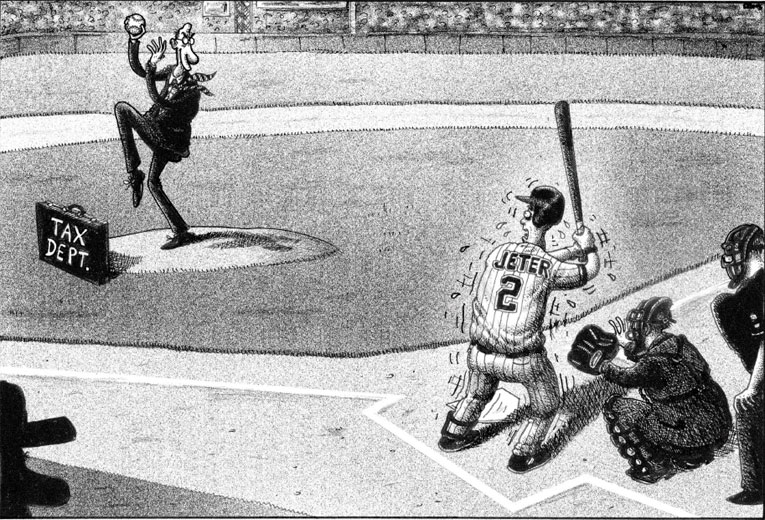
People of all income levels have moved from high tax states to tax free states, such as Florida and Nevada. Often, they’re shocked to see that their overall tax burden is still more than they would like due to much higher sales and property tax rates in those states with no income tax.

As I constantly warn people when planning such a strategy, income from services rendered and property owned inside states with income taxes will still require paying those states their share. This applies to everyone, but is more dramatic with the big money earners, such as professional entertainers and athletes. Rush Limbaugh always mentions how much he has to pay in New York taxes when he broadcasts from his studio there instead of from his main home base in Florida.

There is currently a high profile case with baseball player Derek Jeter that is getting some press.


(Click on image for full size)

Posted in comix, StateTaxes | Comments Off on Florida as tax home…

Capitalizing startup costs…

Posted by taxguru on November 18, 2007

Q:

Subject: Depreciation on web site enhancements and portal additions

We are an HMO with website for “E-Health”, designed to enable employees, clients, brokers, practitioners, etc to access info on claims, broker checks, practitioner info/update etc.  We have previously expensed costs associated with this site, to the tune of 800K.  


We are now expanding, adding portals, new software, accessibility, info expansion, in the amount of 1.2 million, using third-party vendors. Is there any part of this that can be capitalized?  (Can we change horses in midstream)?


Additionally, we have a contract vendor on-site.  We pay them a monthly fee for maintaining all our applications.  All this is expensed as consulting.  If we use folks from this contract pool to develop, train, implement this project, we can’t very well capitalize these costs.  But if we have a special “project contract” with this vendor, for a certain cost, etc., wouldn’t we be able to capitalize this labor?


Thanks for your help–our object is to capitalize as much as possible.  If there is a good place to go (besides you!) to get answers, please let me know.  I’ve downloaded every IRS publication I can find on depreciation already and haven’t found an answer.


A:

I don’t mean to cop out on this kind of issue; but there is no place to go to help decide how to properly handle the capitalization of start-up costs.  There are several ways in which it can be handled.  That kind of decision requires a lot of analysis of your past, current and future circumstances by an experienced professional tax and accounting advisor. This is in no way something you can do on your own.

Frankly, I find it shocking that you would invest two million dollars in a business start-up without the assistance of tax and accounting professionals from the very beginning.  That is extremely reckless and dangerous on so many fronts.  If that was all your own personal money being used, I guess you will be learning some expensive lessons.  However, if you are using money from outside investors, operating without competent tax and accounting professionals, you are exposing yourself to lawsuits by the investors for fiduciary negligence.

I realize this isn’t the kind of response you were expecting; but anything else would be irresponsible.

Good luck.

Kerry Kerstetter


TaxCoach Software: Are you giving your clients what they really want?


Posted in Uncategorized | Comments Off on Capitalizing startup costs…

Buy SUV personally or through LLC?

Posted by taxguru on November 18, 2007

Q:

Kerry,

I currently have a day job where my gross pay will be around $110,000 for 2007.  I also own a 60% stake in an LLC, seperate from my $110,000 job.  I need to buy an SUV for my LLC for about 80% business and my use only. In respect to Tax Code Section 179, what is my best strategy for buying a $30,000 SUV that is section 179-eligible? Can I personally take the Section 179 tax break? Or do I get only 60% of the section 179 deduction? Can I take the section 179 deduction on my own or does it have to be through the business?  Your help is greatly appreciated.


A:

This is the kind of thing you should really be discussing with your own personal professional tax advisor because there are a lot of factors to take into consideration.

Tax-wise, you could achieve pretty much the same benefits either way; buying it personally or through the LLC.

From a more practical sense, what would concern me more is how you and your partner in the LLC can ensure that you are each getting your fair share of the deal.  It’s an easy enough task to specially allocate the Section 179 for the purchase to your K-1.  What gets messier is how to allocate the operating expenses.  Are you going to pay them personally or is the LLC?  The person who is handling the tax and accounting work for the LLC should also be part of this decision process to see if it would just be cleaner to have each of you take care of your vehicles on your own, which is what I frequently see with situations similar to yours.

There are obviously other factors to consider when working with a multi-owner business that wouldn’t be a concern for a company owned by a single person or a married couple. 

Good luck.  I hope this helps you and your personal professional tax advisor work out the best game plan for your unique circumstances.

Kerry Kerstetter


Follow-Up:

thanks for the response Kerry!


Posted in 179, LLC, Vehicles | Comments Off on Buy SUV personally or through LLC?

Other kinds of employees?

Posted by taxguru on November 18, 2007

Posted in comix, Employees | Comments Off on Other kinds of employees?

Posted by taxguru on November 18, 2007

Posted in comix | Comments Off on

Squeezed…

Posted by taxguru on November 17, 2007


(Click on image for full size)

Posted in comix, TaxBurden | Comments Off on Squeezed…